
GM, COT❣️ Yuzunoko here.
When you talk about a work you don't like, do you separate "I wonder about the way this is drawn" from "this work shouldn't be published"?
In the debate around the manga Regista!, criticism of how the work depicts sexual content has collided with a defense of freedom of expression. On top of that came a comparison with The Apothecary Diaries, the age categories for BL and TL, and the opinion that how bookstores display these titles should be reviewed. (BL, or boys' love, and TL, or teens' love, are genre labels used in publishing. They are not legal age ratings.)
Whether you like the work is not enough to settle the matter. Some people want to question how the work is drawn, and others want to protect the freedom to keep publishing it. Even when both say that both freedoms matter, there are cases where what they are concretely asking for differs.
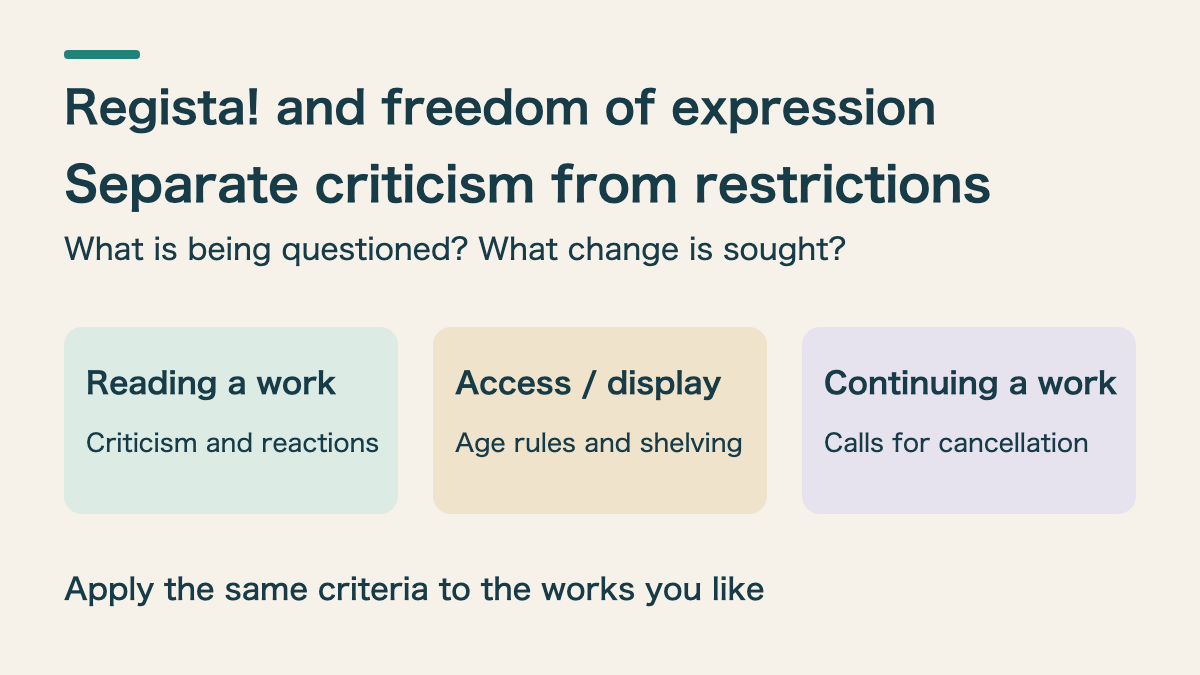
This article organizes the points of dispute based on the publisher's description of the work, publicly readable posts and criticism, and the Tokyo Metropolitan Government's explanation of its designation of publications. To give the overview first: criticism of a work, age-based access rules and arrangements for how it is sold, and demands that serialization stop are each separate matters.
Categories such as "for men" or "for women" alone do not determine a work's content or its readers' views. I will read each strong post without extending it into the opinion of everyone of the same gender or the same genre.
First, what can be confirmed
The relationship described in the official introduction to Regista!
In Shogakukan's introduction to Volume 2, the protagonist Hanada is a 36-year-old freelance lyricist. The other main character, Shinozaki, is a third-year high school student who works part-time at a supermarket. Hanada meets Shinozaki across the register counter, falls in love at first sight without knowing Shinozaki's background or age, and cannot take a step forward, according to the description.
From this introduction we can tell that a relationship between characters with an age gap is at the center of the story, and that the work depicts the protagonist's confusion. On the other hand, a short official synopsis alone cannot determine how the whole work presents things, or how individual scenes should be judged.
What the protagonist does within the story, what kind of pictures the reader is shown, and how the author positions that way of drawing are separate questions, even if they overlap.
This distinction is needed on both the critics' side and the defenders' side. A synopsis alone cannot declare a work guilty or innocent, and reading only clipped scenes does not amount to having read the whole work. Conversely, the mere fact that the synopsis mentions inner conflict does not invalidate criticism of how the pictures are presented.
Tracing the public posts, different questions overlap
On October 25, Yu@Presenter posted asking women to share their experiences of being troubled by advances from older men. In that post, Yu added a speculation that men who claim Regista! is "not creepy" probably lack contact with such people and therefore have "insufficient resolution" in their understanding. Yu also wrote that this had been true of Yu too.
On October 27, Kohki Watabe offered criticism of the relationship between the psychological conflict within the story and the visual pleasure given to the reader. The character struggles with the idea that he must not lay a hand on a minor, yet the reader is shown the underwear-clad body of that minor female character, with its sexual aspects emphasized and without narrative necessity. Watabe describes this relationship as "betraying" the psychological conflict at the level of visual pleasure.
In publicly available writing, CDB opposes attacks on Regista! and also argues that The Apothecary Diaries, which became the point of comparison, should not be excluded merely on the grounds of whether it is ethically correct.
In yufuko's post of November 5, the recent developments are described as a "backlash" from "men on the free-expression side" against labeling and calls for serialization to stop by the critics. yufuko calls the comparison with The Apothecary Diaries "mirroring" and expresses sympathy for some people having changed the direction of their activity. yufuko also claims that BL and TL books equivalent to 18+ are displayed flat on bookstore tables, a treatment that would not be allowed for works aimed at men. This article has not verified yufuko's account of the critics' motives or of the state of bookstore displays. Mikage's post of the same day, through a recollection about a ban on crossdressing, prompted readers to think about rules that would also apply to themselves.
This is a lineup of public statements that could be confirmed. It is not a timeline establishing who started the controversy. Nor can it be said from these posts that all critics demand the end of serialization, or that all defenders want to regulate works aimed at women.
(Even when people seem to be talking about the same topic, the questions they are trying to answer may differ.)
What are the people who object to the work concerned about?
Within "dislike" lie experiences and questions about how the work is drawn
If the reaction were only that someone doesn't like romance with an age gap, that would be each reader's taste. But the criticism made public this time involves separate concerns: real-life experience, and what the work shows its readers.
On real-life experience, Yu's post is one example. It can be read as raising the issue that the discomfort with the work should be considered together with experiences of unwanted advances from older men.
On the other hand, the view that men who are not bothered by the work lack experience is a generalization that includes a guess, which Yu marks with "probably." This article does not treat it as fact.
Even if the people who enjoy the work have no ill intent, those who see it may recall their own experiences and be distressed. There is no need to decide that putting such experiences into words is itself an enemy of creative work.
However, the stories that were gathered are not the same as evidence that the work caused real-life nuisance behavior. Who the post reached and what kinds of people responded was not random either. Accepting that troubling experiences exist, and attributing their cause to a specific manga, need to be considered separately.
Criticism that asks about how things are shown to readers, not only about the protagonist's actions
Watabe's criticism cannot be captured by the question of whether the protagonist actually laid a hand on the other person. In the text he wrote after reading through Volume 3, he gives examples such as a changing scene and panels that show a character's underwear at large size.
He then argues that Hanada's inner conflict becomes an "alibi" for readers to look at a sexually emphasized female body. His wording for the depiction is "soft porn at the very least." He also takes issue with the fact that the technique of using women's bodies sexually to catch the reader's eye has been repeated in general-audience magazines.
Under this reading, the explanation that "the protagonist is hesitating" is not an answer to the criticism. The target of the criticism is both the characters' ethics and the way the pictures are constructed to guide the reader's gaze.
At the same time, Watabe states explicitly that fiction may depict even base or ugly desires, and that this principle cannot be bent. He evaluates the work's use of gaze and space, and says he likes the work.
However, he continues that if stereotyped expressions such as the sexual objectification of women circulate in large quantities and affect real-world perceptions and behavior, they should not be left alone. The scale of that influence and its causal relationship are his view and have not been verified in this article. This can be read as a position that acknowledges the freedom to draw while taking the influence on reality seriously.
He further says that, depending on how it is drawn, it "would not be bad if it were done within an 18+ framework," while adding that the problem of making women's bodies a means of attracting readers should be considered separately from this one work. Criticism of the work's expression and the discussion of what framework to deliver it in appear side by side within his own writing.
Liking a work and criticizing part of how it is drawn are compatible. If we draw a line saying "if you really liked it, you wouldn't criticize it," there is quite a lot less we can say about works.
Where does criticism end and a different demand begin?
What matters in response to a criticism is what is being asked for on the basis of that concern.
Explaining why "there is a problem with this way of drawing." Sharing an impression that "this isn't suited to certain readers." Requesting that a bookstore separate sections: "please separate the sales floor." Asking a publisher to stop a serialization: "please end the series." These differ in the size of the change they demand of the other party and in the grounds required.
The responsibility for the strongest demand cannot be placed on everyone who has doubts about a work. Conversely, it is also wrong to recast a statement that actually demanded cancellation as having merely given an impression. We need to look at the actual words of the person who spoke.
With the materials confirmed for this article alone, the full extent and scale of the demands to stop serialization cannot be known. This article distinguishes between yufuko and CDB taking issue with moves to stop the work and the factual details of individual demands.
What do the people who defend the work want to protect?
Depicting something in fiction is not the same as approving of it in reality
At the center of the defending position is the idea that depicting a relationship or desire within a creative work does not mean recommending that it be done in reality.
A work in which undesirable acts or irreconcilable desires appear does not exist solely to affirm them. There are stories that think through the characters' hesitation, failure and contradiction. Between the presence of elements that look inappropriate and the judgment of whether the work may be published, an explanation is still needed.
CDB opposes the treatment, for both Regista! and The Apothecary Diaries, that says a work must not exist unless it is correct. This is a position that applies the same principle even to expression that departs from one's own tastes, rather than granting an exception only to works one likes.
The defenders also rebut the criticism on the content of the work itself. CDB says that Hanada in the work has not even touched the other person, and that there is "not even nuisance behavior, let alone illegal behavior." yufuko also worries that what is being criticized is "an all-ages romantic comedy that is neither porn nor erotica," and that if such exclusion were accepted, all-ages works could be canceled without limit.
How to see the sexual elements of the work is directly at odds with the critical reading. Watabe evaluates the changing scene and others as soft porn. In another scene, he says the straightforward understanding is that Hanada tried to photograph the other person in a state where underwear was visible and was stopped. However, he himself reserves that a reading that detaches it from the main plot as a gag is also possible.
These are each author's evaluations of the work. Whether the protagonist actually acts and how sexually explicit the images shown to readers are remain separate questions, and this article does not decide which reading is correct.
From this position arises a concern about making a work unpublishable simply because "there are people who find it unpleasant." Since unpleasantness differs from person to person, if it alone were the standard, even works one cherishes could be excluded on the grounds of someone else's unpleasantness.
However, merely saying it is fiction does not make criticism of any way of presenting it impossible. Allowing something to be drawn and agreeing with how it is drawn are different. Protecting a work does not require silencing readers' impressions and criticism.
Do not decide a reader's character from the depiction alone
Treating a reader as approving real-life nuisance behavior because they like a work is a leap. Which part of the story a reader is reading, which character they sympathize with, and how they receive the pictures and staging differ by reader.
The same can be said of the opposite side. Just because someone said they found the work unpleasant does not mean they want every kind of expression banned.
Even if there is a rough generalization in someone's statement, using it to explain the whole of the other side takes the discussion further away. What was supposed to be a discussion about a work turns into imposing images of people: because they are men, because they are women, because they are readers of that genre.
What is needed when rebutting is not to select only the other side's roughest remark, but to show what in the claim is sound and what is a leap. That work is unglamorous, but it becomes material for third parties to judge by.
Those who hold up freedom of expression are also asked to explain
Protecting a work from criticism does not mean you need not listen to criticism. For example, a person who reads the protagonist's conflict as weighty can explain how that conflict relates to criticism about the sexual way things are shown to readers.
If all of the other side's concerns are dismissed as "confusing reality with fiction," criticism of the composition of the pictures and of the way the story is told is dropped as well. Thinking about what a depiction brings to mind in reality is itself part of reading creative work.
At the same time, the general proposition that expression is connected to reality and the claim that a particular work produced a particular harmful effect are verified in different ways. Bringing something to mind, making viewers uncomfortable, and actually increasing certain behavior are each confirmed differently.
If we are to make clear what we are protecting, it is both the ability to publish the work and the ability to present differing readings of it. Both the critics and the defenders of the work need to give reasons for whatever they demand beyond that.
Separating the comparison with The Apothecary Diaries from the zoning discussion
What is the purpose of applying the same standard?
The comparison with The Apothecary Diaries combines an aspect of asking for consistency of standards with an aspect of bringing in another work as a counterattack. CDB wrote that it was like a counterattack that spread to The Apothecary Diaries, and yufuko calls it "Apothecary mirroring." Both writers state that the comparison had an aspect of being brought out as a counterattack. Their evaluations differ, however: CDB calls the spread "sad," while yufuko says it is "understandable" that some people changed direction.
Here, let's first consider the question of whether the reasons directed at a work one dislikes can also be applied to a work one likes.
CDB argues that if a rule were made that one must not take sexual action toward another person without their consent in a work, The Apothecary Diaries would fall under it and Regista! would not. CDB then shows a position not of saying that therefore The Apothecary Diaries should be excluded too, but that both works may exist.
Such comparisons are an effective way to check whether a rule is merely a restatement of taste. "Ban A because I dislike it, make B an exception because I like it" is not an explanation that can persuade people who like A.
However, a rebuttal is possible that even when works seem to depict similar relationships, their positioning within the work, the characters' viewpoints, and the consequences of the acts differ. Explaining those differences should not all be dismissed as a double standard.
When making a comparison, you first need to put into words what you are treating as the same standard. Is it the age gap between characters, the strength of position, the handling of consent, or the sexual explicitness of the pictures? If the standard shifts midway, people give answers that talk past each other even when looking at the same example.
"Ban both" and "ban neither" are different answers
After pointing out an inconsistency of standards, there are several answers. Accept both. Consider the same age categories for each, based on concrete depictions. Show reasons enough to treat them differently. Make neither publishable. These are not the same conclusion.
yufuko supports demanding the same zoning for works aimed at women as for works aimed at men, calling it a natural demand. This is an opinion that concerns the compatibility of freedom of expression with protecting children, and fairness of treatment.
yufuko has already answered, in advance, the concern that this is an expansion of regulation. The claim is that if treating works for women the same as works for men damaged freedom of expression, freedom of expression would already have been damaged. yufuko positions it not as creating new restrictions but as a matter of balance with the treatment that works for men already receive.
A strong counterargument to this opinion is the concern that demanding fairness might become an expansion of new restrictions on expression. If you think it is unjust for the works you like to be restricted, the question becomes whether restricting works the other person likes dissolves that injustice.
Conversely, if there is a difference in how existing rules are applied, then telling people "don't increase regulation" while leaving that unaddressed is no answer for those who feel it is unfair. We need to separate whether the problem is adding new prohibitions, applying current rules, or revising toward a less restrictive standard.
It is hard to choose only for or against while leaving this difference vague. What do you want to change, and for whom would what kind of constraint increase? Without specifying that, even the same word "zoning" leaves people talking about different things.
Impressions, display, age categories, and continued publication are different points
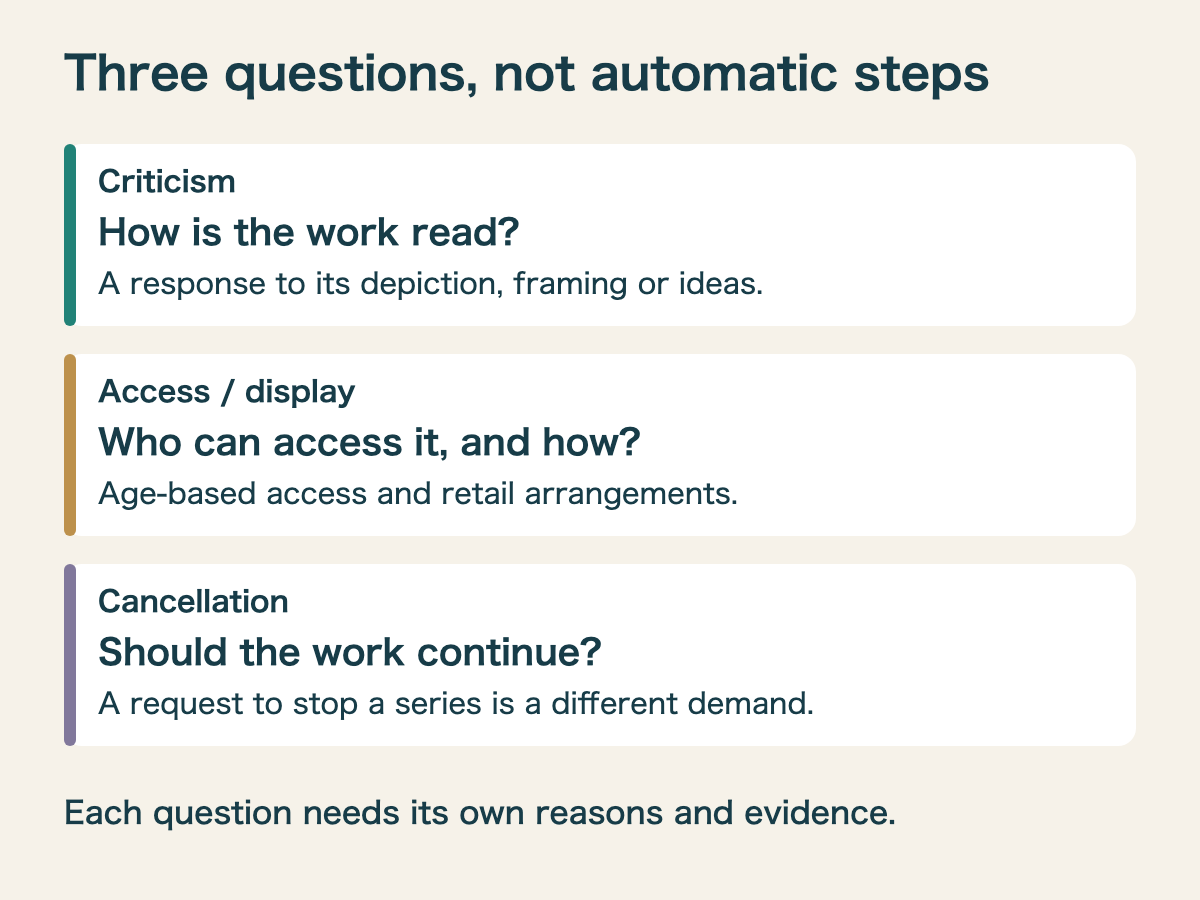
In this debate, zoning is used to mean separating who reads a work and where it is seen. However, age labeling, the arrangement of bookstore sales floors, and designation by government authorities are not the same mechanism. Nor is any of them the same as a decision on whether to continue a serialization.
As a concrete example, let's look at the announcement the Tokyo Metropolitan Government published on May 14, 2026, concerning the designation of books under Article 8 of its ordinance. The announcement explains that designated books must not be sold or lent to persons under 18, while clearly stating that sale and lending to adults are possible.
It also presents several methods for wrapping and separate display. The Metropolitan Government also explains that violating the restriction on sales to young people may result in a fine of up to 300,000 yen. Being designated cannot be read as immediately meaning that no one can buy the book. Conversely, it cannot be flatly said that because adults can buy it, there is no impact on creators or sellers.
The books designated in the same announcement include titles whose label name contains "TLcomics." However, this is a designation made for individual books following a council recommendation, and the reason given is that they markedly stimulate sexual feelings and risk impeding the sound growth of young people.
It is not material showing how undesignated books are displayed in bookstores, or the difference in treatment between works for men and works for women. yufuko's main concern is bookstore display, and this one example neither supports nor refutes that claim. This article does not claim to have investigated the state of display in bookstores as a whole.
The Tokyo example is also not used as an explanation that the same system applies nationwide. Nor does this article judge whether individual works meet the designation requirements.
Do not lump BL and TL together by the strength of a single depiction
A genre name alone cannot explain the degree of a work's depiction or its readers' age category. If you group things as "because it's BL, everything is the same content," or "because it's for men, everything is adult-oriented," you lose sight of what should specifically be compared.
If you are considering fairness of display, it seems better to list points that can be compared under the same conditions: the content of the work, what is visible on the cover, age labeling, and the location and operation in bookstores. A feeling that "that genre is favored" alone does not settle what should be fixed.
One can point out problematic treatment. But extending constraints to all creators and readers of a genre because a reader of one work criticized another work is a different judgment. The individual who criticized and the people who make works in the same genre are not the same.
Conversely, it does not follow that, because it is a genre one likes, there is no need to consider age categories or sales floor placement. The conditions of explaining the necessity concretely and matching it to the actual content are required of both sides in the same way.
What the example of crossdressing asks
Is it a rule that comes back to apply to oneself?
What Mikage posted on November 5 was a recollection about a certain event organizer.
To someone who found men wearing women's clothing distasteful and asked for it to be banned, the organizer replied that women wearing men's clothing would then be banned too. After the person answered that this would be a problem, the organizer told the participants that such a thing must not happen.
The organizer's name, the year, and records from that time cannot be confirmed from this post alone. Here I introduce it not as a story whose reality is established, but as a question that the posted recollection raises.
What I want to think about in this story is that if expression is banned solely because "there are people who find it distasteful," that same reason will come back to apply to the expression one likes. It is also a question of whether we support that rule only when what we ourselves dislike disappears.
There is no need to read the story as endorsing a ban on either men wearing women's clothing or women wearing men's clothing. In light of the post's ending, it can be read as an example of asking whether people could participate together under the same rule, before excluding one side on the basis of the other's taste.
(If you think about a rule meant to apply only to the other side coming back to apply to you, things look different.)
Even so, the conditions of comparison still need to be checked
However, this example cannot be applied as is to every dispute. Discomfort with a certain expression, a concrete safety problem, and age-appropriate access categories are not the same kind of reason.
If an event were to explain that a particular costume poses a physical danger, that could be considered separately from a reason like dislike. Even then, it would need to explain what is dangerous and whether the same rule applies to costumes with the same conditions. This is not saying that such a danger actually existed at the event in this recollection.
As for manga, too, one cannot dismiss every discussion of age categories for concrete sexual depictions as an imposition of likes and dislikes. On the other hand, using the words "age category" does not entitle anyone to demand restrictions on others' works without checking the content.
This recollection is useful not because it automatically produces individual conclusions, but because before putting a judgment into words, it lets us swap our own position once and think. When the same grounds are directed at a work we like, can we accept that treatment? And if we would still change the treatment, can we explain why?
Separately from the event in this recollection, the viewpoint of discussing taste in works, the way the body is displayed, and the concrete conditions at the venue separately can also be used when thinking about cosplay participation rules. That is exactly why we would like to hold together two things: not deciding other participants' presence solely on someone's disgust, and discussing concrete conditions.
Even without reaching the same conclusion, there are things that can be checked
"Critics" and "defenders" alone cannot sort everyone
The positions seen so far do not split neatly into two. There are people who criticize how a work is drawn while recognizing the freedom to draw. There are people who defend a work without denying that it has undesirable elements. Asking for fairness of standards and being cautious about increasing regulation are also compatible.
It cannot be said that "since they criticized the work, they must want to silence the author." Nor can it be said that "since they said they protect freedom, they must not care about real-life troubles." Both add conclusions that are not in the other person's statements.
Similarly, the act of citing other works includes both comparison to check a standard and attack meant to trouble the other party. The fact of having compared does not decide which. We need to read as far as what they call the same and what they are asking for before judging.
Do not treat what is not yet known as known
With the materials confirmed this time alone, we cannot establish the full extent of the moves to demand an end to serialization, the actual bias in display, or the effect individual manga have on real-world acts. Likewise, the accusation that fake work images made with AI were spread, and the claim that a particular group set things in motion, are not supported in this article.
Placing these with the same weight as "one side says this, and the other side says that," while leaving them vague, is not the same as neutrality. What could be confirmed, whose opinion it is, and where there is still no support: showing these separately gives readers more to think with.
Where an original post has corrections, those corrections need to be read together with it. Clipping out only part of strong wording is convenient for both criticism and defense, but then it becomes impossible to see what the dispute was about.
This article is not a review that decides the merits of Regista! after reading all volumes. It organizes the content of the discussion, taking as its sources the introduction published by the publisher and the public writing of the people covered here. It also does not treat The Apothecary Diaries as something whose individual depictions can be evaluated and settled by this article alone.
Words about a work, and words that change how a work is treated
Whether you want to protect a work you like or convey why something was uncomfortable, you can begin by separating what you are asking for.
Do you want to discuss how it is drawn? Do you want to share a choice not to read it? Do you want to change how age or sales floors are handled? Do you want the work to stop being published at all? The further you go toward the last demand, the more concretely you need to explain its target and reasons.
If you ask this of the other side, you carry out the same check for expression you like. If there are different conditions, you put those into words too. Following this procedure does not make tastes or conclusions match. But what you oppose and what you can accept becomes a little easier to talk about.
Being able to put into words both that you like a work and that you have doubts about some part of it makes the time we spend talking about works richer, I think❣️
This article is based on materials checked on November 6, 2026. It distinguishes opinions and experiences described in posts from the government's explanation of its system, and it makes no legal judgment on any specific work and no assertion about how bookstores as a whole operate. Quotes from Japanese sources are our own translations. Translated from the Japanese original.
See you next time on COT❣️
Sources: Regista!, Vol. 2: Publisher synopsis (Shogakukan) (Japanese), Yu @Presenter’s post of October 25, 2026 (X) (Japanese), Kohki Watabe’s post of October 27, 2026 (X) (Japanese), Whose Resistance to What Is Regista!? (Kohki Watabe) (Japanese), The Apothecary Diaries and the Question of Correctness (CDB / 774notes) (Japanese), yufuko’s post of November 5, 2026 (X) (Japanese), Mikage’s post of November 5, 2026 (X) (Japanese), Designation of Publications under Article 8 of the Tokyo Metropolitan Ordinance on the Healthy Development of Youth (Tokyo Metropolitan Government, May 14, 2026) (Japanese)