
GM, COT❣️ Yuzunoko here.
When you post cosplay photos on social media, have you ever stopped to think about copyright?
This actually came up between 2020 and 2021, when the Cabinet Office (the government body that supports the prime minister) minister in charge of the Cool Japan strategy (the government's push to spread Japanese culture overseas) talked about it at press conferences.
These days, the Agency for Cultural Affairs has also published a copyright explainer that uses cosplay as an example.
In this article, I'll lay out what the government's published materials say, along with examples of rights holders' guidelines that talk about cosplay.
This isn't meant to give you a legal answer, and I'll say that again at the end.
What came up at the Cabinet Office minister's press conferences
It started with a press conference on November 27, 2020, by Minister Inoue, Minister of State for Special Missions at the Cabinet Office (in charge of the Cool Japan strategy).
While announcing that the appointment ceremony for cosplayer Enako as a Cool Japan Ambassador would be held on December 9, the minister said, "we are also aware that legal issues can arise with regard to cosplay and copyright," and expressed the intention to work toward an environment where cosplayers can enjoy themselves with peace of mind.
When asked what kind of environment specifically needed to be created, this is how the minister answered.
Apart from exceptions like private use, copying and the like generally needs permission from the copyright holder. On top of that, the minister explained, some have pointed out that legal clarification is needed for "cases where people take photos in character, or post those photos on social media, or take part in events and get paid."
Taking photos, posting them, getting paid. So the parts of cosplay worth checking got split into those three situations.
The minister's explanation of the "rules" reports
At a press conference on January 29, 2021, the minister brought up reports that had come out "the other day." They said the government planned to move ahead with rules on cosplay and copyright, and apparently raised worries that government regulation would stop people from carrying on as they always had.
The minister explained that this was "not what I meant."
At the same press conference, the minister said cosplay "has not become a major problem at this point," but that some people worry legal problems could come up as the number of cosplayers grows.
In thinking about measures, the minister said the moves of companies that publish guidelines for secondary use, cosplay included, would be a useful reference, and wanted to go ahead with hearings with the people involved and sort out measures by the end of the fiscal year.
I couldn't find what measures the government later came up with anywhere in the government materials I checked for this article.
It wasn't about making regulations, but about creating an environment where people can enjoy cosplay with peace of mind, so it's a bit of a relief for now (considering the uproar back then, I really wish more people had read the full press conference).
What the Agency for Cultural Affairs' explainer says
The Agency for Cultural Affairs, which is in charge of copyright, covers a personal photo shoot in cosplay costumes in Question 3 of its explainer series "Copyright: OK or Not OK?"
Here are the main points.
- First, check whether the work or the company that holds the rights has put out official guidelines
- Characters' costumes and designs can be protected under the Copyright Act and other laws
- Selling photos or videos of protected cosplay without permission "is often not allowed"
- Taking or posting photos of other cosplayers without their consent can lead to trouble over portrait rights (the right to your own likeness) or the right of publicity
- Enjoying it personally "does not immediately amount to copyright infringement." When you publish it online, check the rules
On another page, it also explains that posting on social media is "making it public," so the private-use exception for enjoying something at home doesn't apply.
Some creators quietly let things slide, but "silence is not 'official approval,'" it says.
And that's exactly why the advice is to look for guidelines first.
Examples of rights holders' guidelines
Whether it was the government's press conferences or the Agency for Cultural Affairs' explainer, everything led back to rights holders' guidelines. Here are three that touch on cosplay.
The fan content guidelines from Capcom (a Japanese game company) list "cosplay costumes and photos" among the kinds of work they cover. If you follow the guidelines, you don't need to contact them.
They don't allow commercial use, but they say small quantities and small amounts within a hobby, like at a doujinshi market, are allowed as an exception, and that Capcom makes that call.
They cover individuals or groups without legal entity status, and so nobody mistakes your work for official, you're not to use Capcom's copyright notice.
The guidelines for ANOMALITH, a game from FuRyu (a Japanese game and entertainment company), clearly list among what you can do "cosplaying the characters, and taking, publishing and distributing cosplay photos and videos."
It's limited to individual, non-commercial use, and the standard is that payment at about the level of expenses like materials still counts as non-commercial.
The guidelines for Touhou Project (a long-running indie game series) say derivative work as a personal fan activity is "basically free, within the bounds of common sense." The word cosplay doesn't appear on the current page, but the conditions include clearly stating that it's Touhou derivative work and not making anything that could be mistaken for official.
As a Touhou fan, I'm grateful for how generous that one line is (which is all the more reason I want to stick to the don'ts it does list)
Even when they all allow cosplay, how much they spell out, how they handle money, and how you're supposed to credit the name differ from work to work.
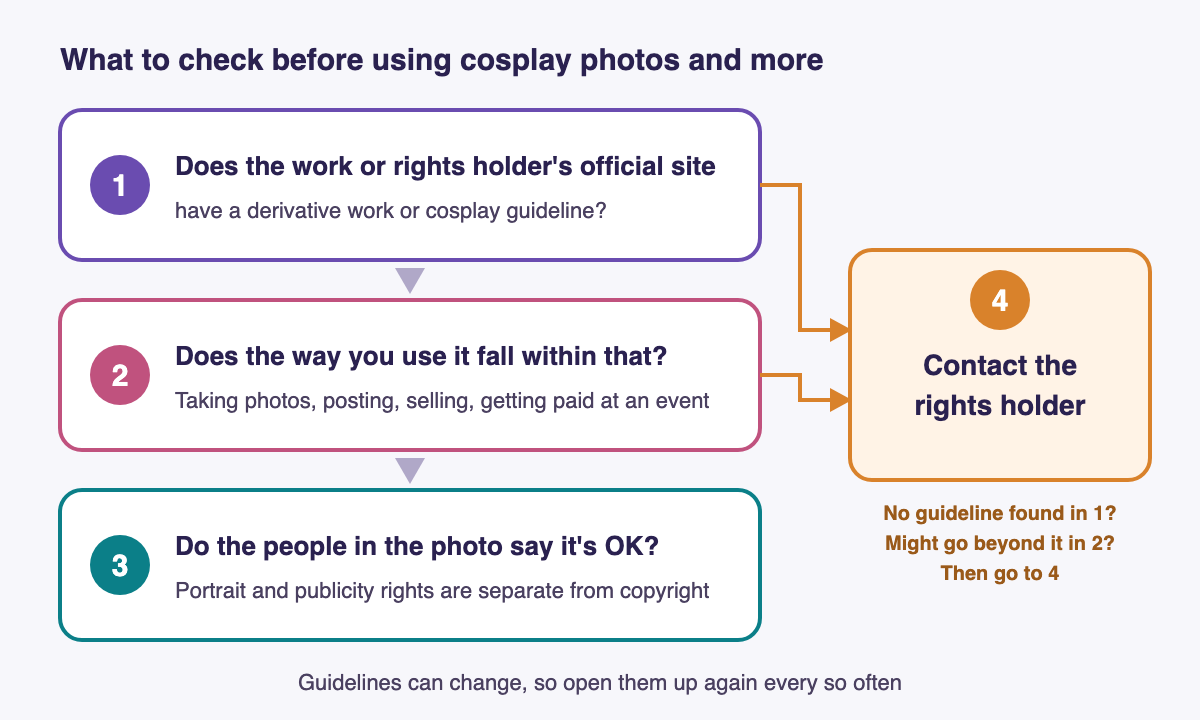
What to check, in order
Based on what these materials say, you can sort what to check into this order.
- Is there a derivative work or cosplay guideline on the official site of the work or the rights holder?
- Does the way you're using it (taking photos, posting on social media, selling, getting paid at an event) fall within that?
- Do you have permission from the people in the photo? (portrait rights and the right of publicity are a separate matter from copyright)
- If you can't find a guideline, or it looks like you'd go beyond it, contact the rights holder
As a diagram, it looks like this.
Guidelines can change. Capcom's guidelines say it reserves the right to change them at any time, and Touhou Project's say they may change without notice.
It's safer not to stop at what you read last time, and to open them up again every so often.
About this article
I put this article together from the Cabinet Office's summaries of the minister's press conferences (November 27, 2020 and January 29, 2021), the Agency for Cultural Affairs' copyright explainer pages, and the derivative work guidelines from Capcom, FuRyu and Touhou Project.
What I've written here are the main points of those materials, and it doesn't decide whether your own activities are legally fine. For your specific situation, check with a professional such as a lawyer, or with the rights holder of the work.
Quotes from Japanese sources are our own translations.
Translated from the Japanese original.
See you next time on COT❣️