
GM, COT❣️ Yuzunoko here.
Do you check the tags on the costumes you wore at events before washing them?
When caring for cosplay costumes so they're ready for their next wear, what you want to check is the laundry care label. Even if you find out it's "washable," that doesn't necessarily mean you can put it straight into the dryer or iron it.
The Consumer Affairs Agency's guide uses separate symbols for washing, bleaching, drying, ironing, and professional cleaning. This time, we'll look at Japan's current care labels to confirm what to check before caring for your costumes.
First, the Tub Symbol: Numbers Are the Maximum Temperature
According to the Consumer Affairs Agency's explanation, the tub shape represents washing by hand or machine. The number inside is the maximum water temperature. For example, "40" means up to 40°C; it is not a requirement to use water that is exactly 40°C.
The bars beneath the tub also have meaning. Even with the same temperature indication, a single bar indicates milder processing than no bar, and two bars indicate very mild processing. Rather than deciding on a washing machine cycle just by looking at the numbers, be sure to check your washing machine's manual as well.
There are also hand-wash symbols depicting a hand. The current guide lists hand washing up to 40°C and hand washing up to 30°C separately. In addition to checking whether it requires hand washing, look at which temperature condition applies.
If an X is superimposed over the tub, it cannot be washed at home. Please do not reinterpret this as "the washing machine isn't allowed, but washing by hand is fine."
(Before assuming "it'll be fine as long as I hand-wash it," taking the extra moment to check the tag is key.)
Being Washable Is Separate from Bleaching and Drying
Bleaching is indicated by a triangle, and drying by a square symbol. In the Consumer Affairs Agency's chart, bleaches are categorized into "both chlorine and oxygen bleach can be used," "only oxygen bleach can be used," and "do not bleach."
Just because you want to whiten a costume, a washable label alone does not tell you that bleach can be used. Check both the bleaching symbol on the care label and the precautions on the bleach product you use.
For drying, you also need to distinguish between tumble drying in a dryer and natural drying, such as line drying or flat drying. A square with a circle inside indicates tumble drying, while lines indicate natural drying.
In natural drying, vertical lines mean line drying, and horizontal lines mean flat drying. Two lines indicate wet drying without spin-drying, and a diagonal line indicates drying in the shade. The label includes not just where to dry it, but also whether spin-drying is allowed, doesn't it?
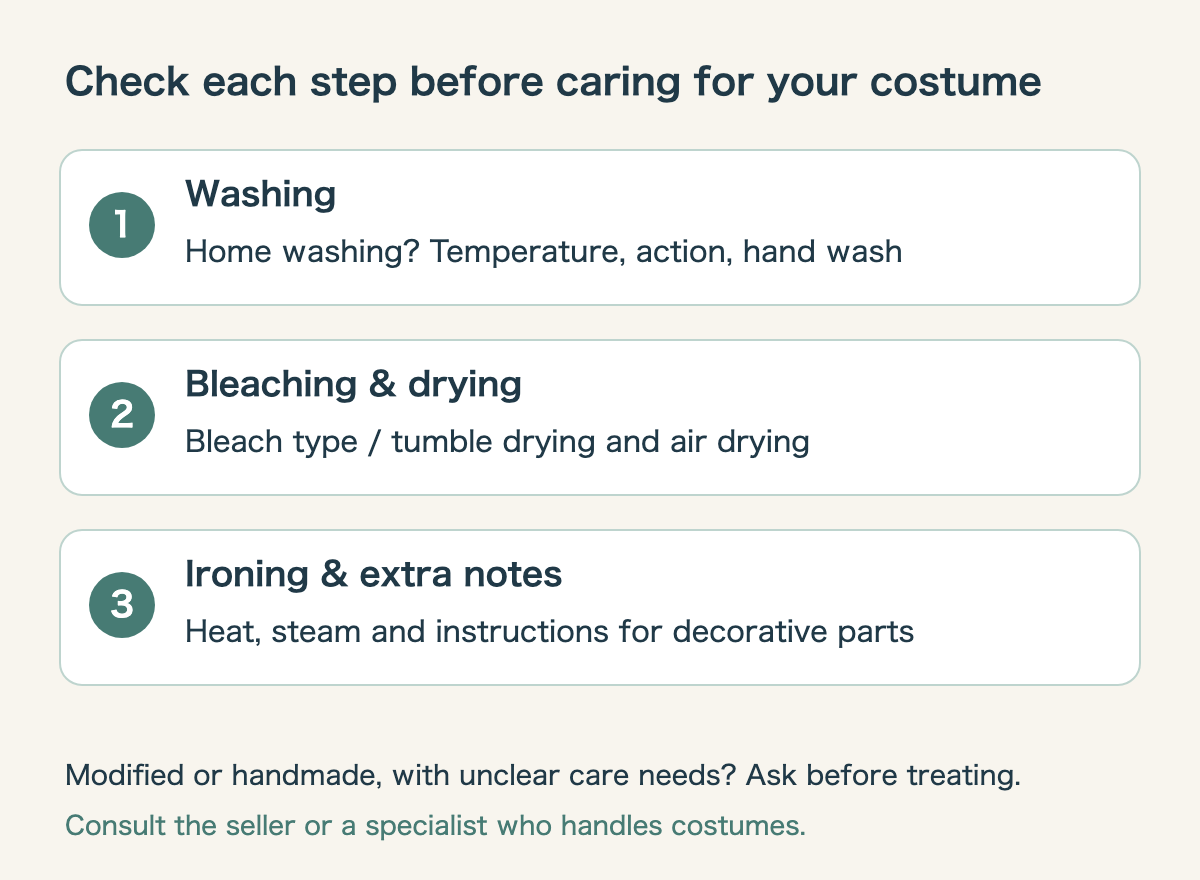
For Ironing, Read Right Down to the Warnings for Decorative Parts
The iron-shaped symbol represents home ironing. The number of dots changes the temperature condition, and an X means it cannot be ironed. Current labels also include a condition for ironing without steam.
Be sure to read the text near the symbols as well. The Consumer Affairs Agency explains that handling methods that cannot be represented by symbols alone can be indicated through "supplementary terms" and similar wording.
Examples listed include "Use laundry net," "Wash inside out," "Wring gently," "Use press cloth," and "Do not iron decorative parts." You'll want to check the symbols for the costume as a whole alongside the cautions regarding trim and decorations.
(Even if you want to smooth out wrinkles in a ribbon, you need to check for the words "decorative parts" first.)
For Handmade or Modified Costumes, Don't Decide by the Original Tag Alone
The Consumer Affairs Agency's guide states that unless special instructions are given, the treatments indicated by the symbols apply to the entire textile product.
However, for costumes where decorations were glued on or other materials were sewn on afterward, you cannot judge that they are washable based solely on the original tag. This is because the Consumer Affairs Agency's guide does not guarantee the washing method for each handmade or modified costume.
If detachable parts have separate labels or instructions, check those as well. When there are no labels, they are unreadable, or you do not know the care conditions after modifications, do not apply water or heat right away—consult the seller or a specialty shop experienced with costumes.
The circle symbol indicates conditions for professional dry cleaning and wet cleaning. If you spot a symbol indicating it cannot be washed at home, show the professional-cleaning symbols and explain the costume's condition when asking for advice.
We want to treasure both the color and shape of our costumes until their next outing❣️
About this article
This article was compiled based on the Consumer Affairs Agency's "Laundry Care Labels (From August 20, 2024 onward)". Rather than applying old labels directly to the current chart, please check the guidance corresponding to those specific labels. We have not conducted washing tests on individual costumes, nor product evaluations of detergents or cleaning services. Translated from the Japanese original. Quotes from Japanese sources are our own translations.
See you next time on COT❣️
Sources: Laundry Care Labels (From August 20, 2024 onward) (Consumer Affairs Agency) (Japanese)