
GM, COT❣️ Yuzunoko here.
Did you buy EVA foam to make armor or a shield, then get stuck on how to bend it or paint it?
EVA foam is a light, soft sheet made by foaming ethylene-vinyl acetate (EVA) resin. It's used a lot for cosplay props: you cut it with a craft knife, bend it with heat, put it together with glue, and finish it with paint.
In this article, I've put together the basics of how to make things with it and the safety points, from official materials published by a foam manufacturer, a craft supply shop, and glue and tool makers.
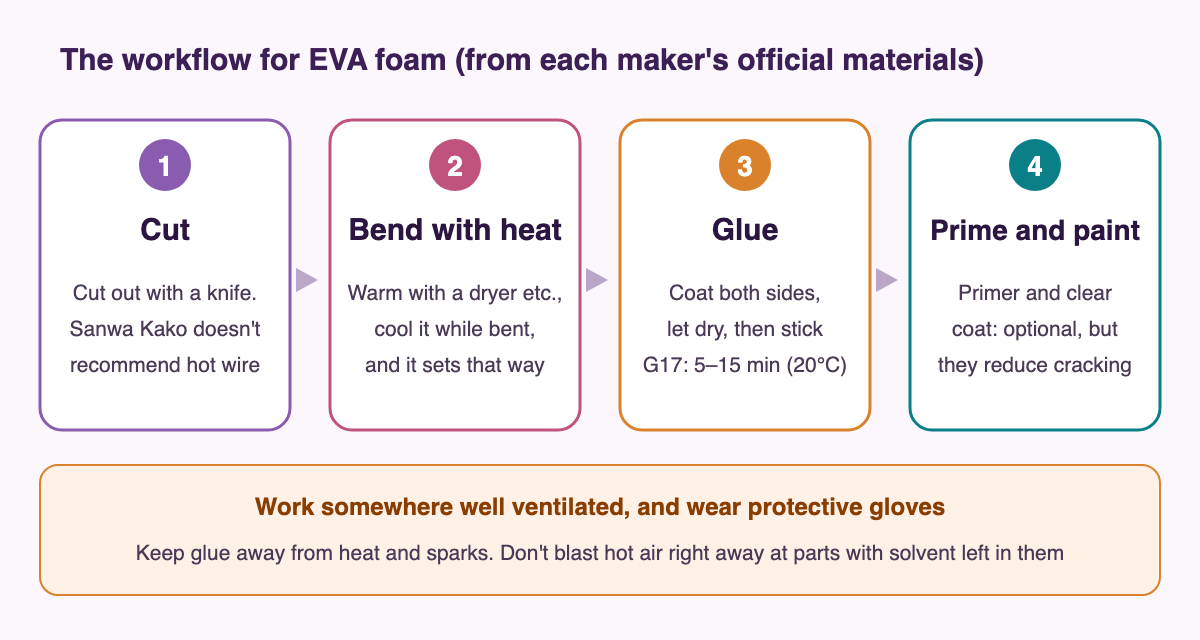
Here's the workflow as a diagram.
What kind of material is EVA foam?
Sanwa Kako, a Japanese foam manufacturer, explains the difference between polyethylene foam and EVA foam on its FAQ page. EVA has low crystallinity, so as a foam it's soft and stretches easily, and it also has a high friction coefficient, which gives it good grip. On the other hand, because its melting point is low, the page says EVA foam has lower heat resistance than polyethylene foam.
Being weak against heat also means it's easy to bend when you're making props. But the same page also warns that foam shrinks and takes shape from heat at lower temperatures than unfoamed resin, so you need to be careful.
The temperature at which general-grade polyethylene foam can be used fairly safely is given as 60°C or below, so with EVA, which handles heat even less well, you'll want to be even more careful (it makes leaving it in a hot car in midsummer sound a little scary).
As for cutting, even though you can physically cut it with a hot wire like styrofoam, the edges warp as they melt and harden, so Sanwa Kako says it doesn't recommend it.
Bend it with heat, then let it cool to set the shape
On its official blog, in a post called "The Basics of Cosplay Prop-Making," the cosplay supply shop Classe explains that its own craft board "bends when you apply heat, and if you let it cool as it is, it sets in the bent shape." It recommends thinner boards for parts you want to fit along the body or around joints, and thicker boards for parts you want to keep flat.
Konishi, a Japanese adhesive maker, also has instructions for a fabric-covered bangle on its cosplay special page. The steps are to cut out a craft board, then apply heat with a hair dryer or similar and curl it inward to give it a shape.
Warm it up, and let it cool while it's bent. Remember that order and you won't get lost.
Besides a hair dryer, you can also use a heat gun to apply heat. Heat guns get very hot, and the instruction manual for Makita's (a Japanese power tool maker) HG6031V heat gun lists the temperature range as 50–350°C on switch 1 and 80–550°C on switch 2.
I couldn't find numbers in any manufacturer's official materials for how many degrees and how many seconds to heat EVA foam. Test on scraps before you use it on the real parts.
Primer and paint: "you can skip them, but they make a difference"
On Classe's blog, to the question of whether primer (base coat) and clear coat (top coat) are absolutely necessary, the answer is "You can skip them!" It then explains that primer helps with color and reduces paint cracking (so it holds up better), and that a clear coat also reduces paint cracking and changes the glossiness.
The same page also covers how to choose a board color. The basic idea is to go with whichever is closer to the color you want in the end, and for props like armor where the back side shows, making them in black means the back won't stand out as much when it's seen.
Another option for priming is a coating called Plasti Dip. Plasti Dip UK, the seller in the UK, explains that EVA foam costumes need to be sealed with Plasti Dip before painting.
Whichever primer you choose, check each product's instructions, including how well it works with the paint you'll put on top.
When the paint holds up without cracking as you bend it, silver armor looks so much cooler (painting is the most exciting part❣️)
Contact cement: "coat both sides, let it dry, then stick"
Konishi's special page introduces the rubber-based adhesives G10, G17 and G Clear for prop-making. The drying time guides (at 20°C) are 10–30 minutes for G10, 5–15 minutes for G17 and 5–20 minutes for G Clear. The suggested uses are G10 for large areas, G17 for smaller parts, and G Clear for clear parts or spots that will be seen.
The method is "contact bonding." You apply adhesive to both surfaces you're joining, let the solvent evaporate, and then press them together. The guide is that when you touch the surface, it doesn't string and just barely takes a fingerprint.
The same page also says not to use solvent-based rubber adhesives on styrofoam because they melt it, and to watch out for odor and fire when you use them.
Ventilation, burns and fire
The safety data sheet for Bond G17 (household) classifies G17 as a "highly flammable liquid and vapor," and it contains organic solvents such as cyclohexane, acetone and n-hexane. It also says it "may cause organic solvent poisoning," and lists precautionary statements like these.
- Keep away from heat, hot surfaces, sparks, open flames and other ignition sources
- Use only outdoors or in a well-ventilated area
- Wear protective gloves
- Do not breathe mist, vapors or spray
The heat gun's instruction manual also says that working on plastics and similar materials can release harsh, toxic gases, so always ventilate the work area and use a dust mask. It also warns that heating one spot continuously can cause smoke or fire, and that the nozzle is very hot right after use and can cause burns.
Putting the two documents side by side, one says not to use a heat gun near volatile flammables such as paint thinner, and the other says to keep the adhesive away from heat and sparks. To be safe, avoid blasting hot air right away at parts that still have adhesive solvent in them.
About this article
This article is based on Sanwa Kako's FAQ, Classe's official blog, Konishi's cosplay special page, the safety data sheet for Bond G17, Makita's heat gun instruction manual, and an article from Plasti Dip UK. Foams, adhesives and paints each differ in the temperatures they can handle and what they work with, so before you start, check the instructions and safety data sheet for the products you actually have.
Quotes from Japanese sources are our own translations.
Translated from the Japanese original.
See you next time on COT❣️