
GM, COT❣️ Yuzunoko here.
When you see "up to 180°C" on a heat-resistant wig, do you set your hair iron to 180°C?
Most cosplay wigs are made of heat-resistant fibers that you can style with heat. But the heat resistance printed on them is the upper limit, meaning "it can take up to this much," and it's sometimes listed separately from the temperature that's actually right for styling. On top of that, the guideline differs from maker to maker.
In this article, I've gathered the numbers that three Japanese cosplay wig makers, Assist Wig, Classe, and Aquadoll, publish officially, along with how to wash your wig.
The heat limit and the recommended temperature are two different numbers
On Assist Wig's product pages, the spec section says "Heat resistance: up to 180°C (optimal styling temperature 105°C–120°C)." Two products, a short wig and a long wig, were written the same way.
So the limit is 180°C, but what works best for styling is 105–120°C.
On Aquadoll's product page, the heat resistance field says "Curling irons, flat irons, and dryers can be used up to 180 degrees (around 130 degrees is best)." It goes on to say that setting the temperature too high or heating for too long can damage the wig.
At Classe, the heat limit depends on the type of wig. According to their comparison chart, PRO, made for styling, is heat-resistant to 160°C, and SARA, which tangles less, to 170°C, and both can be used with irons and dryers.
Each maker's guideline, side by side
Lined up, the three makers' numbers look like this.
- Assist Wig: heat-resistant up to 180°C, optimal styling temperature 105–120°C
- Aquadoll: can be used up to 180 degrees, around 130 degrees is best
- Classe: heat limit is 160°C for PRO and 170°C for SARA; set your iron to "the heat limit minus 10°C"
Classe's guideline comes from "How to Flip Out Your Wig" on its official blog. Working at low heat doesn't get the heat into the fibers, so the style doesn't set well, while high heat can frizz them up past the point of no return, so they want you to remember: "Set your curling iron or flat iron to the wig's heat limit minus 10°C."
Here it is as a chart, with the upper limit and the recommended guideline separated.
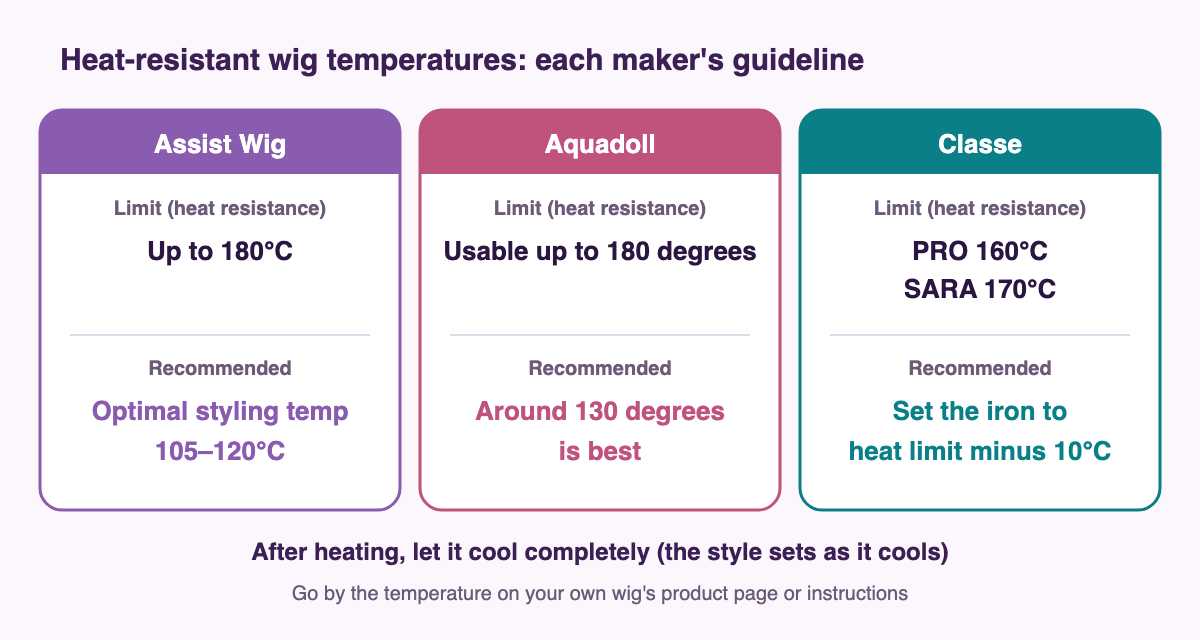
Even at the same 180°C rating, one maker recommends 105–120°C and another recommends 130°C. Since the guideline differs by maker, it's safer not to apply another maker's numbers as they are (having three different numbers from three makers is confusing at first, right?). If you're not sure, treat the temperature on your own wig's product page or the instructions that came with it as the right answer.
The style sets "as it cools"
Once you've applied heat, the key is not to let go right away.
Classe's blog explains that a wig takes its shape as the heated fibers cool, so you should let the heat you've added cool off completely. Aquadoll's product page also says that human hair curls the moment heat is applied, while a wig curls during the cooling step.
Aquadoll's page also warns that if you really straighten a curly product with a flat iron, the curl may not come back.
Be careful with how hot the iron itself gets, too.
In August 2024, the National Consumer Affairs Center of Japan (a government-backed consumer protection body) put out a warning about children getting burned by hair irons. Some products can be set to a maximum of 200°C–230°C, and in their tests, it took more than 10 minutes on average after switching off for the iron to drop to 71°C or below.
It's worth thinking about where you put the iron down after you're done.
Wash in water or lukewarm water
Both Classe and Aquadoll publish washing steps, and the flow is almost the same.
- Brush from the tips to get rid of tangles and dust
- Dissolve shampoo in water or lukewarm water and press-wash without rubbing
- Rinse in clean water or lukewarm water
- Press it between dry towels to take out the water
- Let it air-dry somewhere with good airflow, and style it only once it's completely dry
Classe says never to use boiling water when making the shampoo mix, and never to dry it in direct sunlight. Aquadoll also says to avoid hot water because synthetic hair is weak to high heat, and to dry it naturally or with a dryer's cool setting.
So even with a heat-resistant wig, you need to watch the water temperature when you wash it.
As for fabric softener, Assist's Troubleshooting Encyclopedia (their FAQ) answers that store-bought fabric softener is made for clothes, so they can't guarantee its effect or quality. Using wig care products seems like the safe choice.
How often to wash, and when to replace
Aquadoll also gives a guideline for how often to wash. If you wear it every day, about once every 5–10 days in spring, autumn, and winter, and about once a week in summer. If you wear it one or two days a week, about once or twice a month.
They also say to wash it on days you've sweated a lot, or when it starts to smell or tangle.
The guideline for replacing it is roughly six months to a year and a half. When the tips start to frizz, or it tangles so badly that a comb won't go through, it's time for a new one.
You want your favorite character's wig to stay nice for a long time (a wig that's glossy is cute just for that❣️)
About this article
This article is based on the product pages and care pages of Assist Wig, Classe, and Aquadoll, each company's official blog and FAQ, and a warning from the National Consumer Affairs Center of Japan.
The heat limit and the recommended temperature can differ between products, even from the same maker. Before you put an iron to it, check the label on your own wig.
Quotes from Japanese sources are our own translations.
Translated from the Japanese original.
See you next time on COT❣️