
GM, COT❣️ Yuzunoko here.
The manga app or site you read on: have you ever checked whether it's an official one?
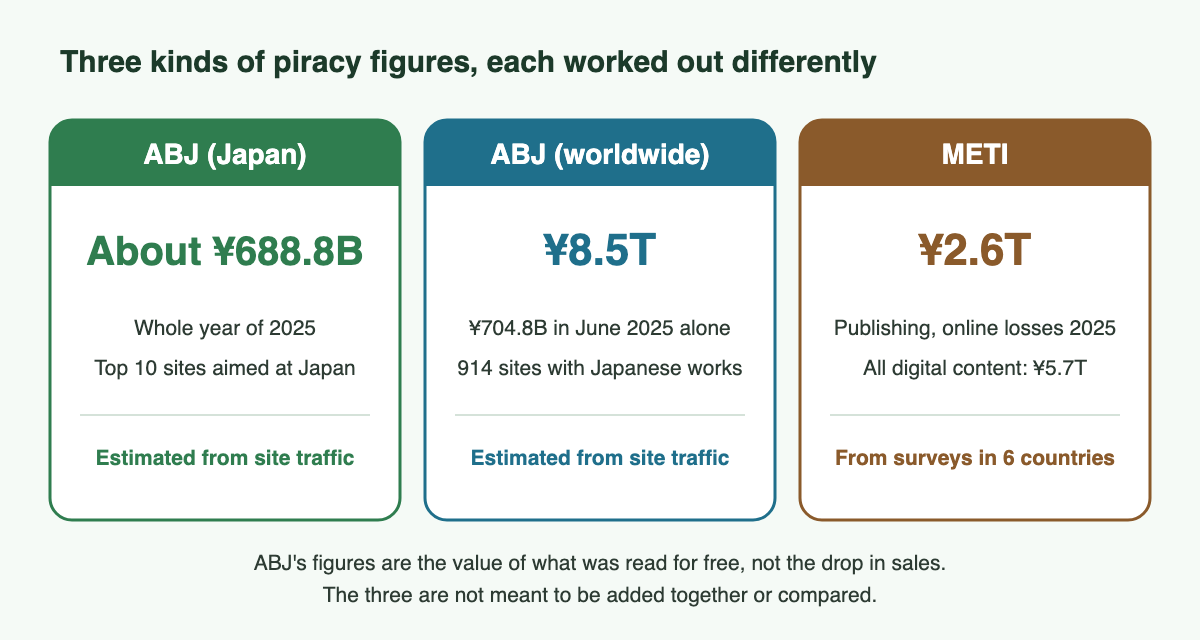
According to ABJ, a general incorporated association formed by publishers and others, the value of what was read for free on the top 10 piracy sites aimed at Japan over the whole of 2025 is estimated at about 688.8 billion yen.
This is a topic full of big numbers, so I'm going to separate them out: which organization each one comes from, and what kind of number it is. In the second half, I also go over how to read the "ABJ mark" that official e-book stores carry.
About 688.8 billion yen on the top 10 sites aimed at Japan
In material ABJ published in February 2026, it estimates, year by year, the value of what was read for free on the top 10 publication piracy sites aimed at Japan.
In 2020 it was about 210 billion yen, and after that it went like this.
- 2021: about 1,001.9 billion yen
- 2022: about 506.9 billion yen
- 2023: about 381.8 billion yen
- 2024: about 806.9 billion yen
- 2025: about 688.8 billion yen (down about 15% from the previous year)
According to the material, several huge sites appeared in the first half of 2025, but countermeasures forced them to shut down, and in December 2025 the combined monthly visits to the top 10 sites fell below 100 million.
The thing to keep in mind is that this is "the value of what was read for free on piracy sites." ABJ itself notes that it isn't the drop in official sales.
With that said, it also writes that if you apply the approach used in research by Japan's Ministry of Economy, Trade and Industry (METI) and others (which assumes about 30% of people would buy the official version if piracy didn't exist), the drop in sales can be estimated at about 230 billion yen.
The estimate only covers the online sites among the top 10 that could be calculated.
"8.5 trillion yen" worldwide, and "2.6 trillion yen for publishing" from METI
Pirate sites that translate manga for overseas readers aren't in the numbers above. So ABJ published a report in November 2025 that looked at piracy sites carrying Japanese publications on a global scale.
According to the report, as of June 2025 there were 914 piracy sites carrying Japanese works, with visits from 123 countries and regions. English was the most common language, at about half.
Assuming 30 minutes and 500 yen per book, the value read for free in the single month of June 2025 comes to 704.8 billion yen. By country, Indonesia came first, then Japan, then the US.
ABJ announced this as "the value read for free worldwide is 8.5 trillion yen."
METI also released survey results on piracy losses for content from Japan in January 2026. It's an estimate based on consumer surveys in 6 countries, and online losses in 2025 came to 2.6 trillion yen for publishing and 5.7 trillion yen for digital content as a whole, including video, games and more.
ABJ's figures come from site traffic and METI's come from surveys, so they're calculated in completely different ways.
They aren't numbers you add together, or compare to decide which one is right (honestly, once it gets into the billions and trillions, my brain just gives up on picturing it).
Here are the three numbers side by side.
The ABJ mark: the sign of an official service
The ABJ mark is a registered trademark showing that the e-book store or e-book distribution service displaying it is an official service that has been licensed by the rights holders.
Its trademark registration number is 6091713. ABJ's official site explains that ABJ stands for "Authorized Books of Japan."
According to an announcement from the Publishers' Public Relations Center (a publishing industry group), the mark went into use on November 30, 2018.
Today ABJ issues it, and the paperwork is handled by the Association for E-publishing Business Solutions (AEBS, a general incorporated association for the e-publishing industry). Whether a mark is issued is decided by a certification committee.
ABJ's overview of its work says that as of August 31, 2026, 269 businesses and 1,032 services had been licensed to use the mark.
The mark is something that e-book stores and e-book distribution services display.
It's a tiny mark, but once you know it's carrying an official seal of approval, it starts to look kind of cool (I also love how it's quietly doing its job somewhere you'd barely notice❣️)
Can't find the mark? Check the list
If you can't tell where the mark is, you can look it up on the "whitelist" on the AEBS site. It's a list of services that display the ABJ mark, and it was updated on September 24, 2026. You can check by seeing whether the app or site you use is on it.
On the legal side, in Japan, from January 1, 2021, the rules on downloading something while knowing it was uploaded illegally were extended from music and video to all copyrighted works. A Q&A from the Agency for Cultural Affairs (the Japanese government agency in charge of copyright) explains that manga is included.
The same Q&A names the ABJ mark as one of the efforts to make official sites easier to tell apart, and mentions that music and video have long had the "L Mark."
According to the Agency's Q&A, simply viewing pirated content isn't illegal, but it also says that it's not something the government recommends.
If you want your favorite artists to keep drawing, reading the official version is the way to go.
About this article
I put this article together from the annual data and survey report published by ABJ, ABJ's overview of its work, the AEBS page on the ABJ mark, the Publishers' Public Relations Center's announcement, METI's news release, and the Agency for Cultural Affairs' materials on making downloads illegal.
The list of services displaying the ABJ mark is updated from time to time. For the services you use, check the latest whitelist.
For legal questions about your own situation, talk to a professional.
Quotes from Japanese sources are our own translations.
Translated from the Japanese original.
See you next time on COT❣️