
GM, COT❣️ Yuzunoko here.
With Touhou Project fan works, have you ever checked the original text to see how far you're actually allowed to go?
Team Shanghai Alice, the creator of Touhou Project (a doujin, or self-published, series of shooting games by ZUN), posts the "Touhou Project Fan Work Guidelines" on Touhou Project Yomoyama News, the site that shares official and officially approved Touhou Project information. The current version was updated on May 31, 2024.
For video streaming, there's a separate set, the "Guidelines for Posting to Video Streaming Services," dated July 8, 2021.
The first sentence of the guidelines is: "Fan works made as fan activity by individuals are basically free, within the bounds of common sense." Right after that comes: "However, please follow the conditions below."
In this article I'll go scene by scene, doujin, commercial, video and games, and lay things out in the guidelines' own words (that "basically free" sentence is honestly a big part of why I love Touhou Project).
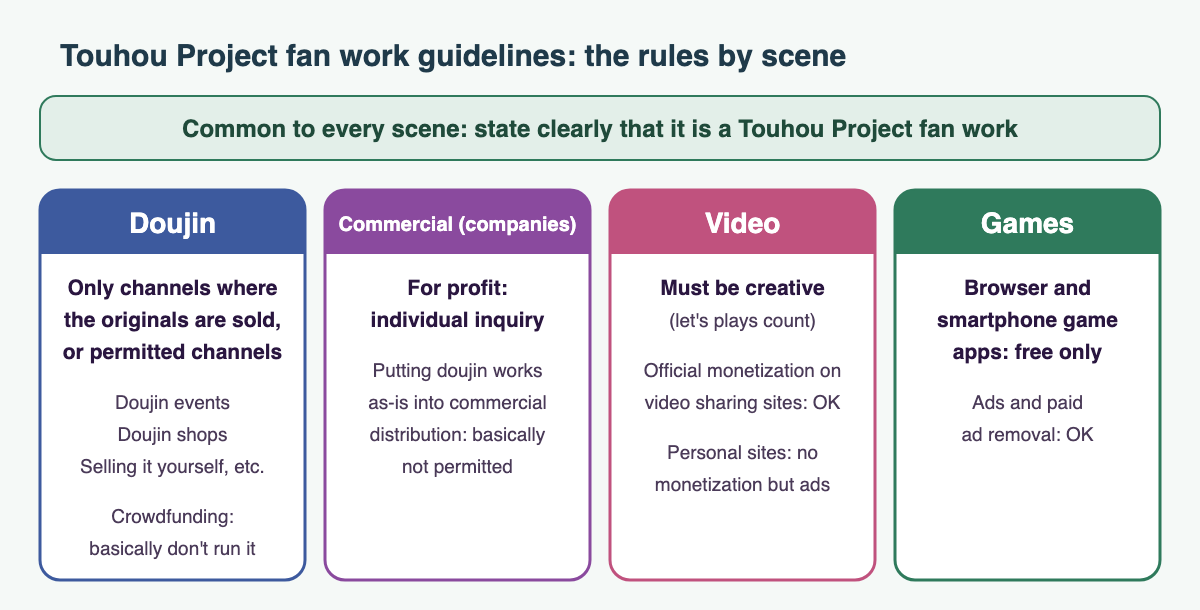
Here are the rules for each scene as a diagram first.
The condition to follow first, and what's prohibited
There's only one condition, and it reads: "Please state clearly that it is a Touhou Project fan work." It applies in every scene.
There are 8 prohibited items. The ones about content are "content that damages the image of Touhou Project," "content that infringes, or may infringe, the rights of others," and "content that could be mistaken for official Touhou Project content."
Also prohibited are "using the original content or fan works to broadcast personal ideologies" and "any other acts judged to be grossly inappropriate by socially accepted standards, such as excessive sexual expression or content that defames specific individuals, groups, races, etc."
On materials, "using or publishing game materials other than screenshots and gameplay videos" is prohibited. So the line is: screenshots and gameplay videos are OK, other game materials aren't.
That said, "publishing the endings of the original games" is prohibited as a separate item, so even in a gameplay video you can't show the ending.
As for other people's work, "reusing fan works without the permission of the person who made them" is prohibited too. It also says: "Editing or publishing photos of ZUN himself without his permission is not allowed."
Distributing as doujin: the channels are set
The rule for distributing doujinshi (self-published comics), goods or music CDs is: "Fan works may be distributed only through channels where the original works are sold, or through channels we permit." The examples listed are doujinshi events, doujin shops (in store and online), and events and channels that have received individual permission.
Other examples include selling it yourself by mail order (limited to items made as a package), e-book sales through BOOK☆WALKER (a Japanese e-book store), and download sales of music through Touhou doujin music distribution. Download stores where the original games are sold, paid events held as circle (doujin group) activities, and indie game sites are treated the same way.
Anything with individual permission should "state that clearly," and for activities that don't fit the examples, they point you to an individual inquiry.
The May 31, 2024 update added an item on crowdfunding. The reason given is "because, as the publisher, we cannot take responsibility for trouble arising from fundraising beyond the scope of individual activity," and it says: "Please basically do not run it."
If you really want to run one, "don't do it without permission; please make an individual inquiry."
Using it as a company or commercially: individual inquiry comes first
For companies, it says: "When a company engages in fan works or fan activity for profit, please make an individual inquiry." It's clearly treated separately from individual fan activity.
The current guidelines state: "The guidelines published so far also remain valid, so for anything not covered on this page, please check the past guidelines."
Looking at ZUN's blog, which is listed among those past announcements, the February 14, 2011 post says: "If a company manufactures or sells Touhou Project works, permission is required (*)." It comes with a note that this excludes copying done on request from individuals, like printing or disc pressing. The same post also says: "We basically do not permit putting something released as a doujin work, as it is, into commercial distribution."
The December 10, 2008 post covers cases like wanting to put an arranged song on your own non-doujin CD or play it live, and explains: "Basically, as long as you credit the source, it's fine."
Streaming videos: it has to be creative, and monetization goes through official systems
The video guidelines open with this sentence: "Team Shanghai Alice regards video streaming related to Touhou Project as part of fan activity (fan works), and permits individuals to stream freely."
The condition is that it's "something with the streamer's own creativity," and it says: "For example, let's plays by the streamer are also regarded as having creativity."
The examples of streams include let's plays of the original games, arrangements of the original songs along with sung and played covers, and drawing the characters (I really hope drawing videos bring us even more cute Reimus and Marisas❣️). When you use someone else's fan work, they ask you to get separate permission from whoever owns that intellectual property.
The sites named as places to post are Niconico Douga (a Japanese video-sharing site), Facebook, Instagram, Mildom, Twitch, Twitter, YouTube, and other video sharing sites (Niconico Douga being listed first of all? Doesn't that make you a little happy?).
On money, it says: "Video streaming for profit is prohibited, but monetization using the official systems of the video sharing sites above is not regarded as for profit, and monetization is permitted." You can also post on a personal website, but "monetization other than ads is prohibited."
Posts that don't follow the guidelines may be contacted individually or removed. If you want to do something as a corporation that doesn't fit these guidelines, they point you to an individual inquiry.
Making fan games: smartphone and browser games free only
Games can be distributed through the same channels listed in the doujin section, including download stores where the original games are sold and indie game sites. On top of that, there's this rule: "Game apps that run in a browser and game apps for smartphones are limited to free ones only."
Being free doesn't mean you can't use any money features at all. It says: "Putting ads in the app, and in-app purchases to remove ads, are OK." Using crowdfunding to raise money for making the game is, as I wrote earlier, basically something not to do.
The guidelines' disclaimer says, "Team Shanghai Alice takes no responsibility whatsoever for trouble caused by fan works," followed by "Please do so at your own risk."
It also says they won't reply individually to inquiries or reports from individuals about the content of the guidelines or about fan work activities.
About this article
I put this article together from the fan work guidelines and video posting guidelines Team Shanghai Alice publishes on Touhou Project Yomoyama News, and the past announcements (ZUN's blog) that the guidelines treat as valid.
The guidelines say, "These guidelines may be changed without notice," so check the latest version on the official pages before you distribute or stream anything.
Quotes from Japanese sources are our own translations.
Translated from the Japanese original.
See you next time on COT❣️