
GM, COT❣️ Yuzunoko here.
Have you ever ironed your costume fabric after marking it, only to find the lines won't disappear?
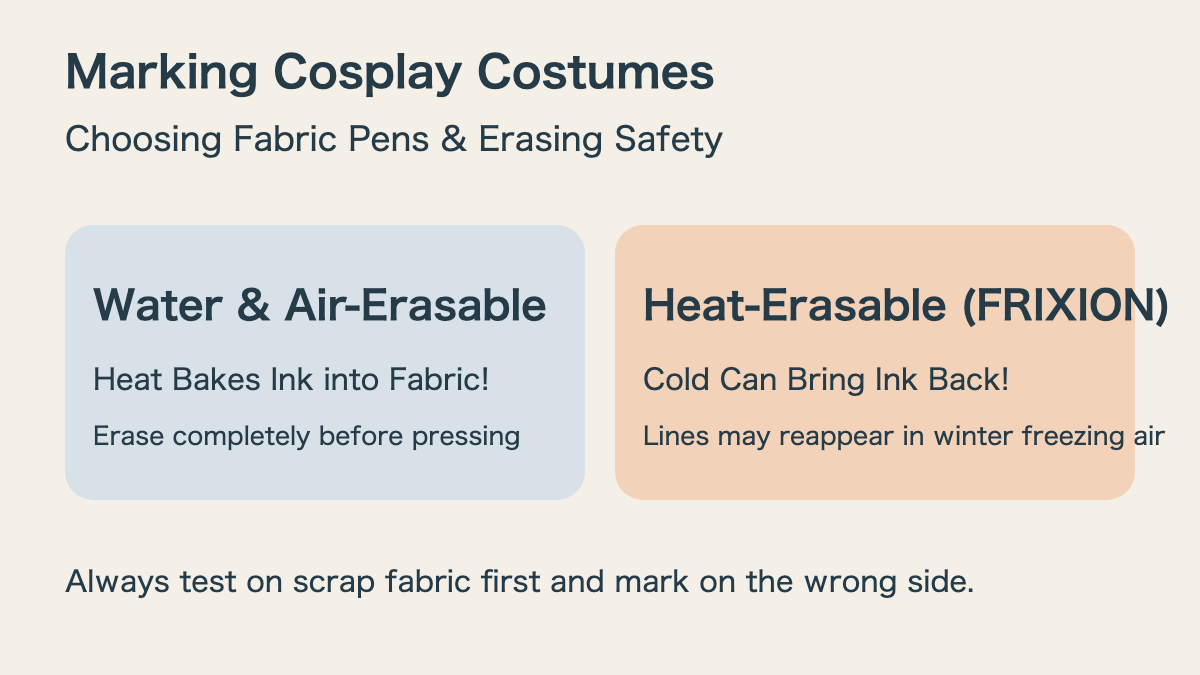
Transferring finished lines and match notches from your pattern onto fabric is a crucial first step in costume making. However, different pens disappear through completely different mechanisms, and getting the order wrong can permanently bake ink into your fabric.
Drawing from official guidelines by Clover and Adger, we’ve put together a breakdown of common marking pens used in cosplay and key check points to prevent craft disasters.
Erase Water-Soluble and Air-Erasable Pens Before Ironing
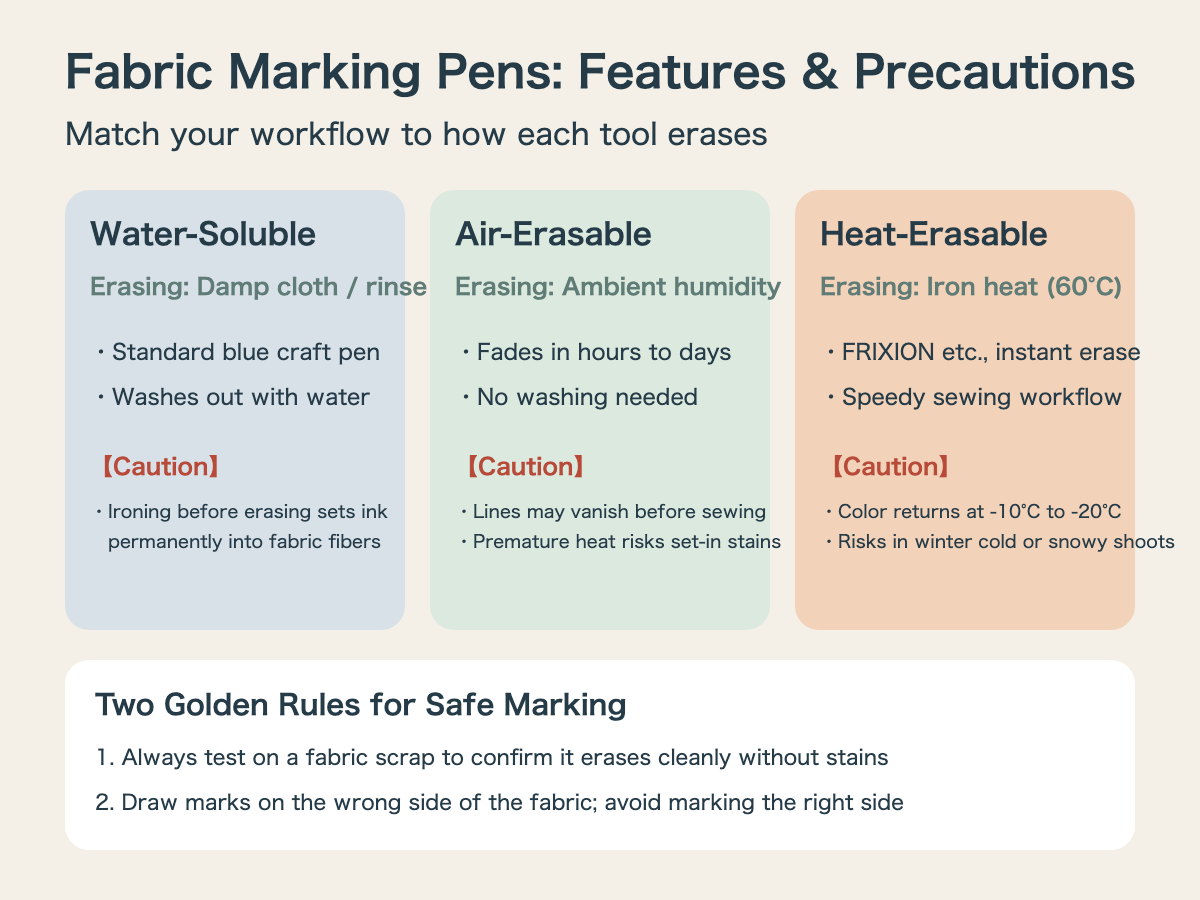
Standard water-soluble marking pens (such as blue ink) from craft stores are designed to wash out with water or by dabbing the marks with a damp cloth.
As Adger emphasizes in their "Ink Characteristics" guide and Clover notes in their instructions, the most critical rule is always to erase marks before applying an iron. Ironing over remaining ink causes heat bonding and chemical changes, setting the marks permanently into the fibers so they never wash out.
On the other hand, air-erasable pens—commonly purple—react with ambient moisture and fade away on their own within hours to a few days (often around 2 to 14 days depending on the product and humidity).
(We’ve all cut out pattern pieces over the weekend, only to sit down the following week and realize every single line has pulled a vanishing act!)
Just like water-soluble pens, air-erasable ink risks setting permanently if exposed to heat before it completely vanishes. Whenever you apply fusible interfacing or press seams, always make sure the marks are entirely gone before bringing out the iron.
Watch Out for Cold Temperatures When Using Heat-Erasable Pens
Heat-erasable pens like FRIXION, which vanish in an instant under an iron, are convenient and popular for costume making.
However, as PILOT explains in their official guidance, the ink doesn't actually break down and disappear—it simply turns colorless at temperatures of 60°C (140°F) and above.
Because of this, the erased ink begins to recover its color when temperatures drop below -10°C (14°F), and completely returns around -20°C (-4°F).
(That means at winter outdoor events, snowy photoshoots, or inside a chilly car, those guidelines you thought you cleanly erased could suddenly come back to haunt you!)
On dark fabrics, heat erasing can also leave behind a faint, whitish sheen. To stay safe, avoid marking visible outer surfaces and stick strictly to the inside seam allowances.
Brush Away Tailor’s Chalk and Powder Before You Press
Traditional triangle tailor’s chalk and powdered chalk liners are designed to be dusted off by brushing or patting the fabric.
If you hit chalk powder with heavy steam and heat, the oils and binders in the chalk can easily leave stubborn marks on your cloth.
Clipping small notches into the seam allowance is another option, though cutting too deep will cause edges to fray. Choosing the right tool for your specific fabric is always the golden rule.
Always Test on a Fabric Scrap Before Marking Your Project
As Adger explicitly states in their precautions—"Always test on a scrap of the same fabric before use"—drawing a quick line on leftover fabric to verify that it erases cleanly is your best safeguard.
Fabric fibers like polyester, cotton, vinyl, or faux leather and their surface finishes dramatically affect ink absorption and erasability. Always test a short line beforehand to ensure it wipes clean with water or doesn't discolor when heated.
As a fundamental rule, always mark on the wrong side of the fabric. You should avoid marking directly on the right side whenever possible.
We all want our cute costumes to turn out beautifully without ruining our favorite fabric.
See you next time on COT❣️
Sources: Twin Water-Soluble Marking Pen (Blue & Pink Fine) (Clover) (Japanese), Water-Soluble Marking Pen (Purple with Eraser) (Clover) (Japanese), Iron Chalk Pen White (Clover) (Japanese), Ink Characteristics (Adger Kogyo) (Japanese), FRIXION High Temperature Ink Decolorization FAQ & Handling Precautions (PILOT) (Japanese)
Quotes from Japanese sources are our own translations. Translated from the Japanese original.