
GM, COT❣️ Yuzunoko here.
Have you ever taken a cosplay group photo where the person in the front was captured sharply, but only the face of the person in the back was blurry?
Even if the point where you focused is sharp, that does not mean everything in front and behind it will be captured the same way. "Who to focus on" and "how much depth front-to-back looks sharp" are connected, but they are two distinct matters.
Drawing from official explanations by Nikon and Sony, let's look at the basics of aperture and what to check when photographing multiple people. This article discusses optical blur using cameras and lenses with adjustable apertures.
Separating the Focus Position from the Front-to-Back Range
Nikon explains "depth of field" as the zone in front of and behind the focused subject where the image appears to be in focus.
When this zone is narrow, it is described as "shallow," and when it is broad, it is described as "deep." This refers to depth in the front-to-back direction from the camera's viewpoint, not the horizontal width of the frame.
For example, imagine photographing people standing at different distances from the camera. If you focus on the face in front, the face behind may look blurry if it falls outside that zone.
If you then shift focus to the person in the back, the person in the front may fall outside the zone this time. Rather than assuming that "because the camera has a feature to detect everyone, there is no need to worry about front-to-back differences," you will want to verify it in the captured photo.
(With costumes and expressions coordinated, you want everyone's face to come through.)
Increasing the F-Number Expands the Range That Appears Sharp
According to Nikon's explanation, holding other conditions equal, the smaller the f-number, the shallower the depth of field, and the larger the f-number, the deeper it becomes.
According to Sony's explanation, decreasing the f-number is the operation of "opening the aperture," while increasing it is "stopping down." The larger the number, the smaller the opening through which light travels.
Sony's "Difficulty Focusing" also advises stopping down to reduce front-and-back blur when only part of the photo is in focus. The operation example shown is setting the company's camera to A (Aperture Priority) mode and increasing the f-number.
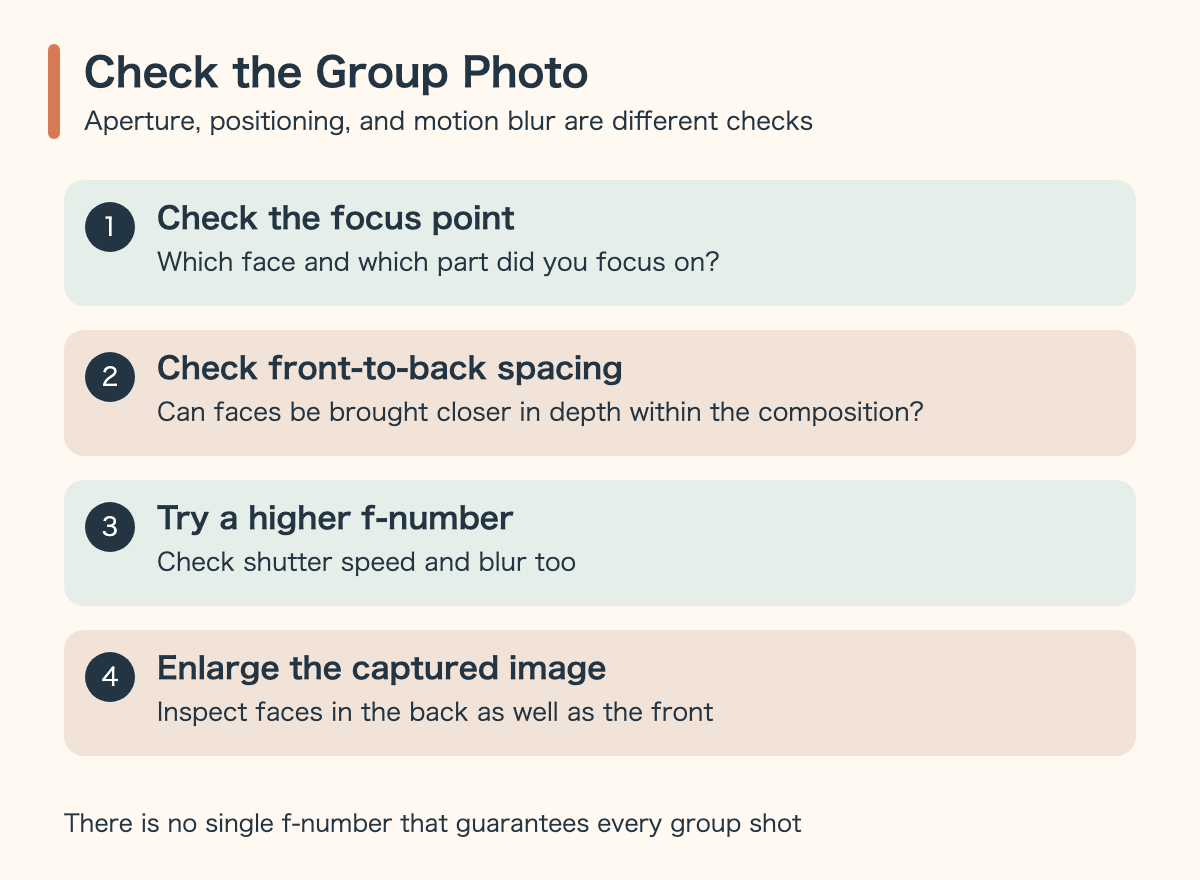
However, one cannot uniformly decide "use this f-number for group photos." Because shooting distance and lens conditions—which come up next—are also involved, it is necessary to check whether everyone's face is sharp with a test shot.
Also Look at the Lineup and Distance from the Camera
According to Nikon, when comparing with other conditions held equal, the shorter the shooting distance, the shallower the depth of field, and the longer the distance, the deeper it becomes. Shooting distance here is the distance between the camera and the subject.
The focal length of the lens is also related: at the same f-number and shooting distance, the longer the focal length, the shallower it becomes, and the shorter the focal length, the deeper it becomes. If you zoom and also change standing positions, multiple conditions shift, so avoid assuming the outcome simply because "it is telephoto."
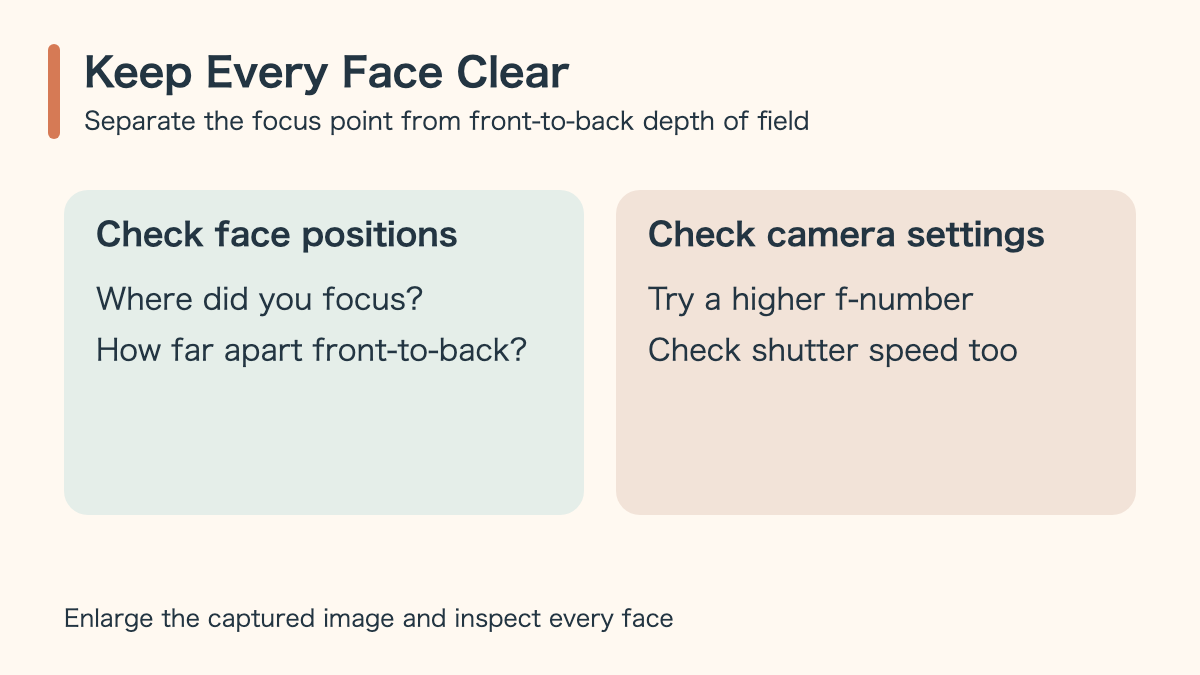
As an application to cosplay group photography, this article proposes first checking whether face positions are significantly separated front-to-back from the camera's perspective. If you can reduce the front-to-back difference within the composition—such as by having only the person in the back step forward—you reduce the front-to-back span that needs to appear sharp.
This is not a manufacturer-specified pose, but a proposal from this article using the concept of front-to-back range. Rather than just aligning feet with markings on the floor, look also at the positions of faces leaning forward or pulled back.
After Stopping Down, Check Shutter Speed and Blur Too
Increasing the f-number is not where it ends. Sony cautions that stopping down in dark places reduces incoming light, making camera shake more likely.
The company's explanation of light levels demonstrates the relationship where light reduced by stopping down is compensated for by slowing the shutter speed. Even with automatic settings such as aperture priority, check the displayed shutter speed after changing the f-number. The actual change also depends on automatic ISO settings and other factors.
Supporting the camera with a tripod or similar equipment is a countermeasure against camera shake, but it does not stop blur caused by people or costumes moving. Even if you widen the range where faces front and back appear sharp, moving during the shot will cause blurring for a different reason.
Cosplay Photo Blur: Was It the Camera Moving or the Costume? Understanding the Difference Between Shutter Speed and Focus covers this difference.
(Rather than feeling relieved that everyone is in the frame, you want to see that everyone's face is clearly captured.)
Enlarge the Image and Check Every Face Before the Main Shoot
Based on official explanations, this article proposes trying the following sequence:
- Check who and which position you focused on.
- Look at the front-to-back differences between faces, and adjust the lineup within a reasonable range.
- If necessary, increase the f-number, check the shutter speed, and take a test shot.
- Enlarge the playback image and check not only the front face but also the face in the back.
Once you change a setting, take another shot to verify. Rather than settling for looking over the whole picture on a small screen, inspecting the face and costume portions you want to preserve makes it easier to think about what to adjust next.
About this article
This article explains depth of field and checks for group photography based on official Nikon and Sony explanations. It does not report real-world shooting tests or guarantee success under specific shooting conditions. Check the manuals for the camera and lenses you use for operation names and adjustable ranges. Translated from the Japanese original.
In a shot lined with cute costumes, the expression of the person in the back deserves just as much care as background blur❣️
See you next time on COT❣️
Sources: Lenses and Depth of Field (Nikon) (Japanese), The Effects of Shutter Speed and Aperture (Sony) (Japanese), Difficulty Focusing: α E-mount (Sony) (Japanese)