
GM, COT❣️ Yuzunoko here.
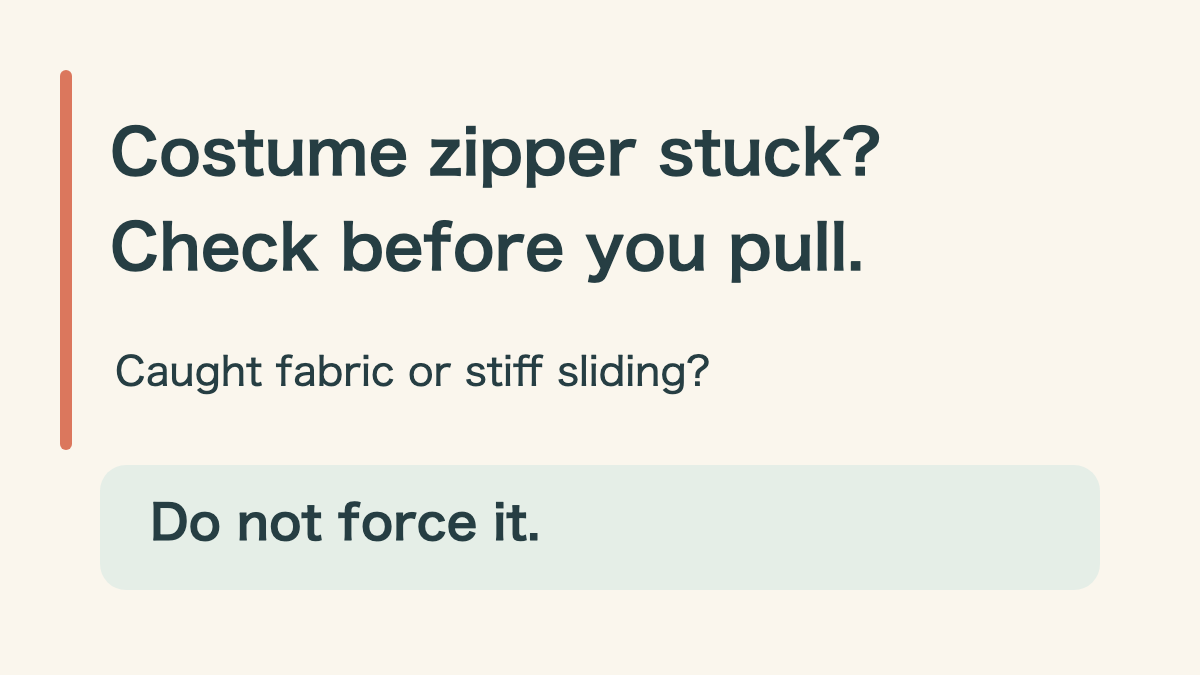
When a costume zipper stops midway, do you try to just pull it right up anyway?
What you need to check differs depending on whether fabric or thread is caught, or if it simply slides poorly. In either case, pulling with brute force to push it through should be avoided.
Based on YKK’s "Proper Use of Zippers" and "Proper Sewing of Zippers," we look at precautions when changing clothes and when making costumes.
When Fabric Is Caught, Back It Up Rather Than Forcing It Forward
YKK’s usage page explains that catching thread or fabric can cause the slider—the part that opens and closes the zipper—to stop moving.
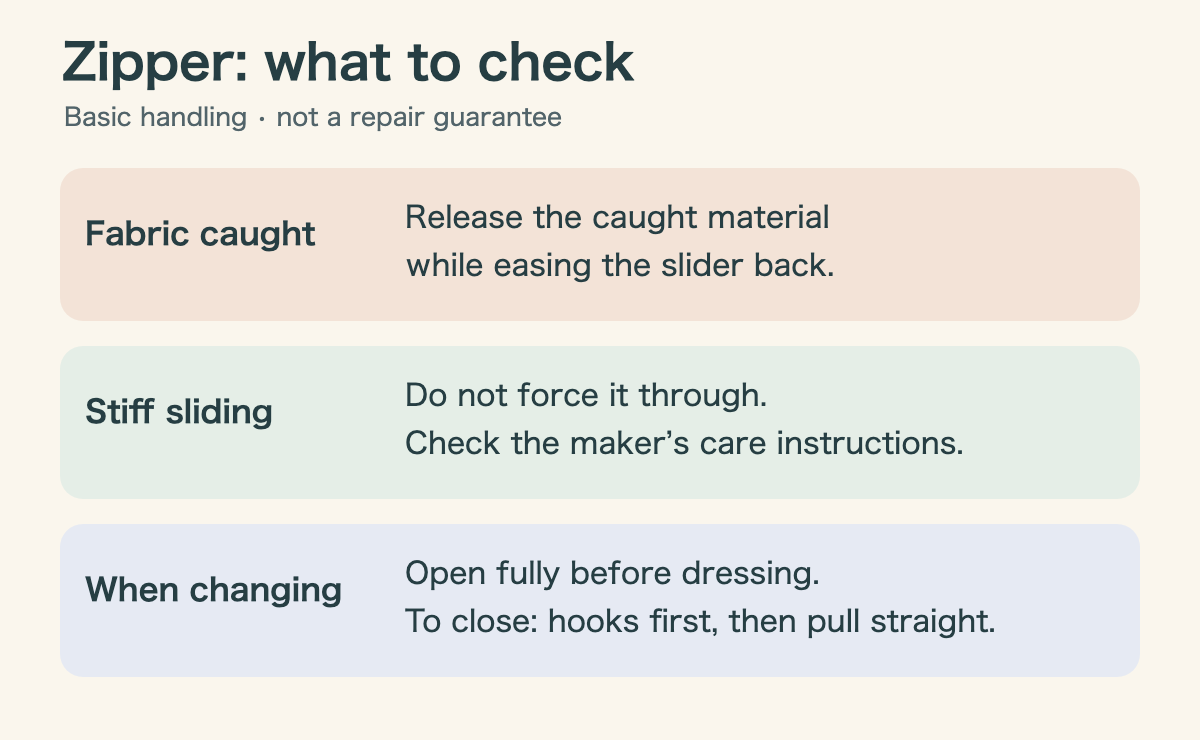
If you force it to move in that state, the snag can become even worse. The guidance advises backing the slider up while gently releasing whatever is caught. Even when it is completely jammed, the explanation is not to move it by force, but to ease it back gradually.
For cosplay costumes, start by checking visible areas to see if lining, decorative fabric, or frayed threads have gotten caught inside. This is an example of applying official cautions regarding fabric and thread to costumes.
The diagram in this article organizes points to inspect. It is not a repair photo demonstrating how to remove snags.
(“It’s almost closed” is exactly when it is worth pausing instead of giving it one last yank.)
Even When It Slides Poorly, Pulling Harder Is Not the Answer
The same YKK page notes that forcibly moving the slider when it slides poorly can cause problems with the "elements"—the interlocking teeth on either side.
As a maintenance method, it describes applying paraffin or their dedicated lubricant spray to both the front and back of the elements, then moving the slider several times to work it in.
However, this article does not verify compatibility for each costume fabric, treatment, or zipper type. Please check the instructions for the product at hand, and do not substitute other oils on your own judgment or assume that applying lubricant while fabric remains caught will fix the problem.
If you see misaligned teeth or visible damage, or if it cannot be eased back smoothly, we suggest not continuing repairs based solely on this article’s explanations and instead consulting the costume vendor or a repair shop. This is to avoid treating every instance of a zipper not closing as a mere sliding issue.
When Changing, Open Completely. Fasten Hooks Before Closing
YKK advises opening the zipper completely when putting on or taking off clothing.
Attempting to force yourself through a narrow opening that is only partially unzipped can damage the elements or the slider’s locking mechanism. Even when taking off a costume in a hurry, you will want to avoid stopping halfway.
When closing, fasten hook-and-eye closures or top buttons first. The official guidance is to pull the slider straight up along the elements so that it does not tilt.
For costumes equipped with hooks or buttons, please also check that sequence. If you have someone help you with a back zipper, this article also suggests telling them beforehand, "Please don't pull it by force."
Allow Clearance for Movement Where Linings Are Sewn
In costume making, along with neatly concealing the zipper, you also want to make sure the slider has room to pass through.
According to YKK’s sewing guide page, sewing right beside the elements may cause the slider to catch the fabric or make opening and closing heavy and stiff. It guides sewing with space on both sides for the slider to pass, advising that linings in particular should be sewn away from the elements.
The required clearance is stated to vary depending on factors such as size and whether it is used face-side or reverse-side. This article does not specify "how many millimeters of clearance is good for all products." Please check the sewing guide for the specific zipper you use and inspect the actual path it takes.
For long zippers, it explains that you should check stretching during wear by basting before final sewing, noting that this verification is especially necessary with knit fabrics.
(A neatly hidden zipper still needs room to move.)
Before Washing, Check Both the Costume Label and the Zipper
YKK advises closing zippers when using a washing machine or dryer. This precaution is intended to help prevent tangling with other laundry items, which could break the zipper or damage fabrics.
It also recommends using a laundry net for pull tabs that are thin or long. There is also an explanation that opening or closing after using a dryer should be done only after the garment’s temperature has sufficiently cooled.
This does not mean that the costume itself is safe to put into a washing machine or dryer. To know whether it can be washed or dried by machine, check the costume’s care label and the handling requirements for its materials and decorations first.
Before Washing Cosplay Costumes: Reading Laundry Care Labels for Temperature, Hand-Washing, Drying, and Decorative Trim Warnings covers how to read care labels for entire costumes.
About this article
Translated from the Japanese original. This article summarizes basic zipper handling based on official guidance from YKK. It does not guarantee repair, washing, or lubricant compatibility for any specific costume. If a specific product comes with designated instructions, please verify those guidelines.
Even with cute costumes, running into trouble when changing is something everyone wants to avoid. If a zipper stops, start by checking whether fabric is caught❣️
See you next time on COT❣️
Sources: Proper Use of Zippers (YKK) (Japanese), Proper Sewing of Zippers (YKK) (Japanese)