
GM, COT❣️ Yuzunoko here.
Have you ever wondered whether gacha (paid random draws for items) in games with NFTs is actually OK legally?
A report put together in December 2022 by the Web3.0 Study Group at Japan's Digital Agency (the government agency in charge of digital policy) says there were concerns that selling NFTs in a form where you can't see what's inside might count as the crime of gambling.
The report then notes that industry groups have set out their views on whether this counts as gambling, together with consumer protection measures such as giving information on drop rates and preventing minors from spending large amounts.
So the government document isn't saying "this is legal." It's saying that the industry groups have laid out their thinking. In this article, I'll line up what those industry guidelines and the Consumer Affairs Agency's documents actually say.
What is a blockchain game?
The "Guidelines on Blockchain Games" issued by three groups, the Computer Entertainment Supplier's Association (CESA), the Japan Online Game Association (JOGA) and the Mobile Content Forum (MCF), define it as a game that includes a system where in-game items and the like are turned into tokens on a blockchain, and can be traded or exchanged by transferring those tokens.
The guidelines were established in May 2021 and revised in July 2024.
The third edition of the "Guidelines on NFT Business" from the Japan Cryptoasset Business Association (JCBA) has a table comparing these with conventional games.
Items in conventional online games can't be sold or lent outside the game, while in blockchain games you can move or sell them outside the game as the owner of the NFT. That's how the guidelines lay it out.
The fact that they might get a price outside the game is where gambling and premiums come into the picture.
How the crime of gambling is laid out
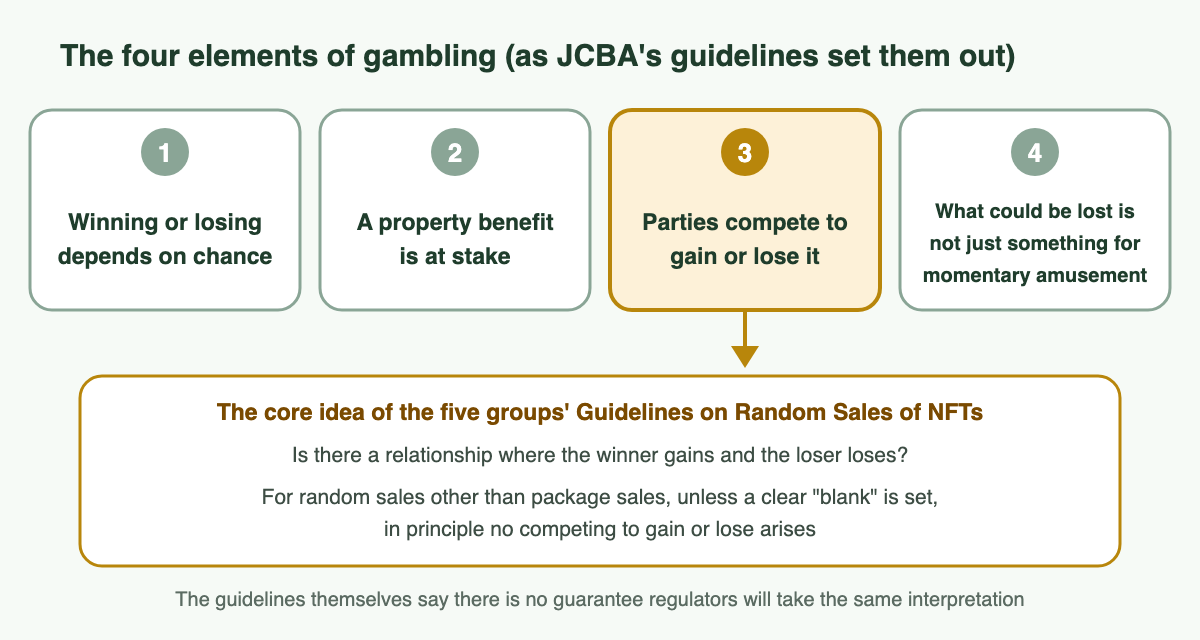
JCBA's guidelines split what makes something the crime of gambling into four elements: winning or losing depends on chance, a property benefit is at stake, the parties compete to gain or lose it, and what could be lost isn't just something for momentary amusement.
They then say that providing rights or value as NFTs isn't gambling in itself, while noting that games using NFTs need care depending on how the service is designed.
The "Guidelines on Random Sales of NFTs," published jointly on October 12, 2022 by five groups including JCBA, bundle gacha, package sales, reveal sales and so on together under the name "random sales."
The core of their thinking is the element of "competing to gain or lose": whether there's a relationship where the winner gains and the loser loses.
For random sales other than package sales, they say that unless a "blank" where no NFT comes out is clearly set, the seller gets the sale price and the buyer gets an NFT worth that price, so in principle there's no competing to gain or lose. Put together with the four elements, it looks like this.
That said, the same guidelines say sellers need to avoid buying and selling on the secondary market themselves, setting their own buyback or resale prices.
The three groups' guidelines, CESA's included, also say in-game NFT items are usually considered a "property benefit," and ask operators not to do things that could make the first sale and the secondary market look like one, such as buying items back themselves.
It's also worth noting that the five groups' guidelines themselves say there's no guarantee regulators will take the same interpretation (so the guidelines are the most careful ones here).
Where the Premiums and Representations Act comes in
The Consumer Affairs Agency explains "premiums" under the Act against Unjustifiable Premiums and Misleading Representations (the Premiums and Representations Act) as economic benefits offered alongside a transaction for goods or services, as a way to attract customers.
On gacha, its document on "complete gacha" explains that "card matching," where you're made to collect different kinds of pictures or the like in a specific combination, is completely banned regardless of the value of the prize. The reason given is that it's highly deceptive and very strongly fuels children's appetite for chance.
The three groups' guidelines, CESA's included, say blockchain games must not offer any service that counts as card matching either.
If items or tokens are attached as a bonus to a paid transaction, they can count as premiums, but if the item is what's actually being bought, it usually doesn't. That's how they lay it out.
JCBA's guidelines say that just issuing NFTs is unlikely to breach the Premiums and Representations Act, but that care is needed in how they're handed out or sold.
There are rules on how things are displayed, too. The five groups' guidelines say to avoid showing higher drop rates or larger planned issue numbers than the real ones, or selling in a way where users can't notice that the rates were cut sharply later, since these could be misleading representations under the Act.
What you can check as a user
The three groups' guidelines, CESA's included, explain that they were also written to help consumers when choosing a service.
The items the guidelines ask operators to cover double as things you can check as a user.
- Are drop rates and planned issue numbers shown?
- Are the ads hinting that prices will go up in the future?
- Is the issuer's contract address public?
- Does it explain that recovery is difficult if you lose your private key?
- Does it say what happens to your NFTs when the service ends?
On use by minors, the five groups' guidelines say it's desirable to ask for a parent's consent and to cap how much or how many times they can spend (the cuter the art, the more you want to keep pulling, so the cap part really matters).
About this article
I put this article together from the guidelines of CESA, JOGA and MCF, of JCBA, and of the five groups, plus documents published by the Consumer Affairs Agency and the Digital Agency's Web3.0 Study Group.
Guidelines are industry groups' views. They don't settle how the law is interpreted, and they may be revised.
This article is not a legal opinion and not a recommendation to buy or sell anything. Whether a particular service breaks the law is something to check with a professional such as a lawyer.
Quotes from Japanese sources are our own translations.
Translated from the Japanese original.
See you next time on COT❣️