
GM, COT❣️ Yuzunoko here.
Do you know where the rules for crypto assets and tokens are decided?
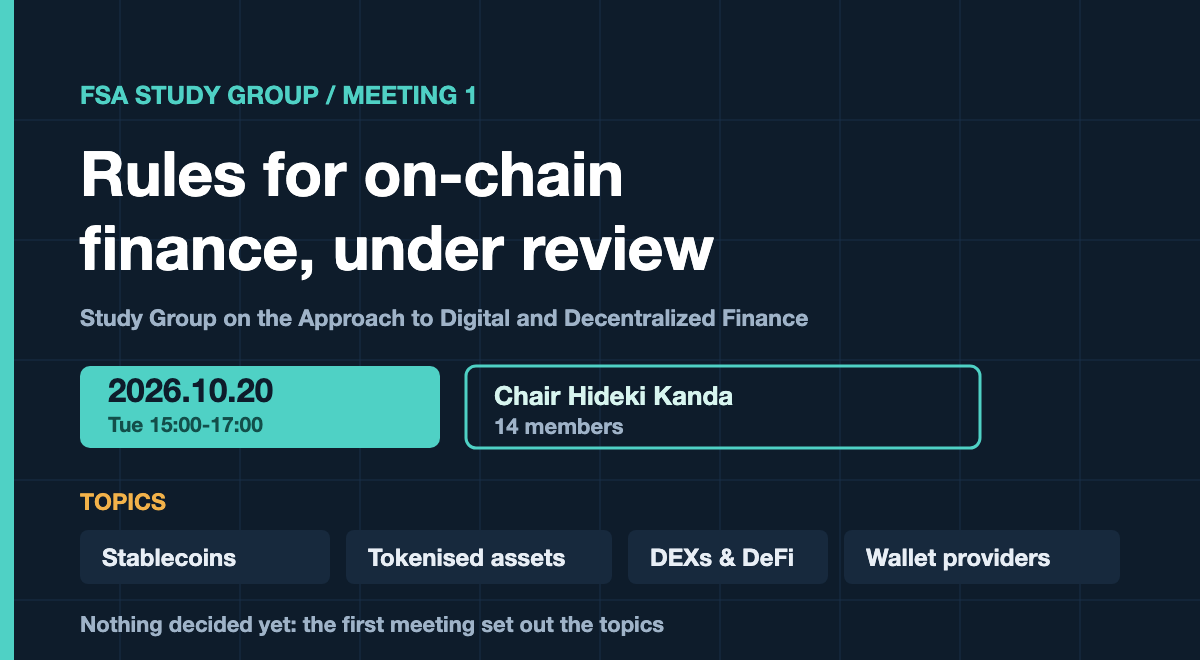
On October 20, 2026, the Financial Services Agency held the first meeting of the "Study Group on the Approach to Digital and Decentralized Finance." The group is reviewing the institutional framework that supports "on-chain finance," where assets and payments sit on a blockchain. The day included a briefing from the secretariat, hearings with two companies, and a discussion.
(The meeting's name is such a mouthful I couldn't memorise it on the first try.)
The first meeting, on October 20
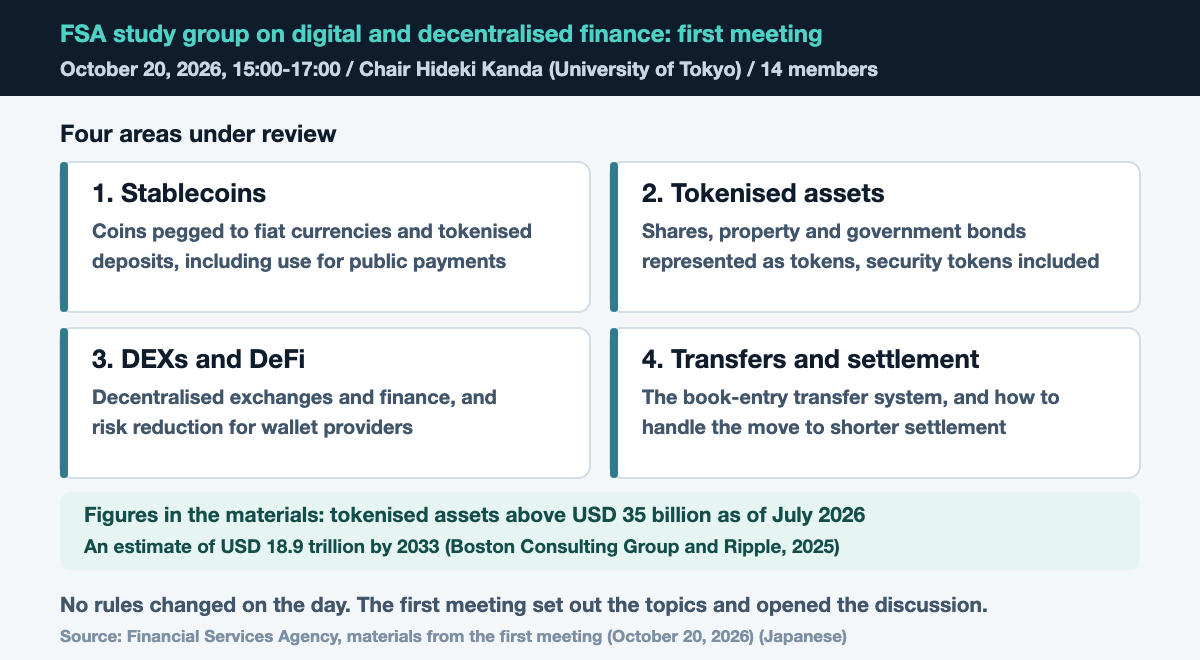
The meeting ran from 15:00 to 17:00 on October 20 in a 12th-floor room at Central Common Government Building No. 7, with online participation as well. The chair was Hideki Kanda, professor emeritus at the University of Tokyo. There were 14 members, among them lawyers, university researchers and a certified public accountant.
The agenda ran through the opening, the secretariat's briefing, hearings with Nomura Holdings and Securitize Japan, the discussion and the closing. Four documents were distributed. The member roster, the secretariat's explanatory material and the two companies' materials are published on the Financial Services Agency's website.
Observers also attended: the Japanese Bankers Association, the Japan Securities Dealers Association, the Investment Trusts Association, the Trust Companies Association of Japan, the Japan Virtual and Crypto Assets Exchange Association, the Japan STO Association, the Deposit Insurance Corporation of Japan, Japan Securities Depository Center and Japan Exchange Group. The Ministry of Justice, the Ministry of Finance, the Ministry of Economy, Trade and Industry and the Bank of Japan took part as well.
What the group will examine
The study group sits inside a larger framework called the On-Chain Finance Forum, which looks ahead to the AI era. The forum was launched in the summer of 2026 and aims to put together an interim summary around early 2027. According to the Financial Services Agency's materials, this study group handles the environment side of that work.
The materials list these subjects for review:
- tokenisation of various assets
- stablecoins
- DEXs, DeFi and wallet providers
- using stablecoins and tokenised deposits for public payments
- clarifying how stablecoins are treated across different laws
- tokenisation of government bonds and other assets
(The first time you see "DEX" and "DeFi," they look like magic spells.)
The final page of the materials sets out three questions under "Matters for discussion." Are there areas that should be examined first as legal issues? For each area, which legal questions should be explored in more depth? And what should be kept in mind when thinking about faster settlement? Those are the three.
Tokenisation today, in numbers
The secretariat's materials also carry figures on the tokenisation market.
Cumulative issuance of tokenised assets has been rising, passing USD 35 billion as of July 2026. There is also an estimate that the global market will reach USD 18.9 trillion by 2033. That figure comes from Boston Consulting Group and Ripple, in 2025.
Other forecasts sit on the same page: Standard Chartered sees USD 30 trillion by 2034, Citi USD 5 trillion by 2030, and McKinsey USD 2 trillion by 2030. Even for the same year, 2030, the gap between USD 5 trillion and USD 2 trillion is more than twofold.
There are domestic figures too. More than 14 million crypto asset accounts have been opened in Japan, and about 70 percent of holders earn under 7 million yen a year. The materials give those numbers as background to the amendment that moves crypto asset regulation under the Financial Instruments and Exchange Act.
DEX rules have not taken shape yet
What stayed with me most was the treatment of DEXs.
DEX stands for decentralised exchange. A 2022 report by the Financial Stability Board (FSB) describes a DEX as "a P2P marketplace based on smart contracts." The image is a place where programs trade with each other, with no person in the middle.
The Financial Services Agency's materials say that "at present, clear regulatory methods have not been established" for DEXs. They go on to say that regulation tailored to the nature of the technology, different from the rules for crypto asset exchange providers, will be studied while watching how other countries move.
For people who offer apps that connect to a DEX to users in Japan, should there be a duty to explain the risks of what the app connects to, and anti-money-laundering measures? The materials say the first step is to understand what those services actually look like. That direction is there too.
International work is on the page as well. In July 2026, the Financial Action Task Force (FATF) published a report on the regulatory challenges of DeFi.
What was decided, and what comes next
By this point it should be clear that nothing was decided on the day. The first meeting laid out the topics and opened the door to the discussion. Rules change only after further debate and, where needed, the legislative process.
The Financial Services Agency's materials say the forum will hold its second meeting in early 2027 and put together an interim summary and a public-private roadmap.
The rules around crypto assets have moved several times in recent years. In April 2017, registration for exchange providers began. In June 2023 came rules for stablecoins and a system for passing sender and recipient information with transfers. In June 2026, a licensing regime for intermediaries that only broker trades started, and in July 2026 the amendment that moves crypto asset regulation under the Financial Instruments and Exchange Act was promulgated. Its main provisions take effect on a date set by cabinet order, so that is still ahead. The story so far is summarised in Crypto assets move under Japan's securities law: what the 2026 amendment enacted, what's already in effect, and what still has no date.
COT is a token with two contracts, one on Ethereum and one on Polygon (ERC-20 and Polygon basics: What does it mean that the COT whitepaper lists two contracts?). The materials deal with the framework, not with individual tokens. Even so, the wallets people use to hold tokens and the rules for the places where they trade connect to what this group is discussing.
(It sounds like distant policy talk, but at the end of the day it is about our own wallets.)
About this article
This article is based on the Financial Services Agency's study group page, the agenda of the first meeting and the distributed materials (the member roster and the secretariat's explanatory material). Dates, participants and figures were checked against those documents.
The discussion will continue. New materials will appear on the Financial Services Agency's website.
This article does not recommend using, buying or selling crypto assets or tokens. It summarises publicly released materials.
Sources: Study Group on the Approach to Digital and Decentralized Finance, FY2026 (Financial Services Agency) (Japanese), Agenda of the first meeting, FY2026 (Financial Services Agency) (Japanese), Member roster of the study group, as of October 20, 2026 (Financial Services Agency) (Japanese), Secretariat explanatory material, first meeting FY2026 (Financial Services Agency, October 20, 2026) (Japanese)
Quotes from Japanese sources are our own translations.
Translated from the Japanese original.
See you next time on COT❣️