
GM, COT❣️ Yuzunoko here.
Have you ever gotten a message on social media from a stranger saying, "Want to grow your money together?"
According to preliminary figures released by Japan's National Police Agency in February 2026, social media investment scams in 2025 numbered 9,538 recognized cases, with losses of about 127.47 billion yen, both up from the year before. In the same release, social media romance scams came to 5,604 cases and about 55.22 billion yen.
Crypto assets come up a lot as the way money gets handed over in scams like these.
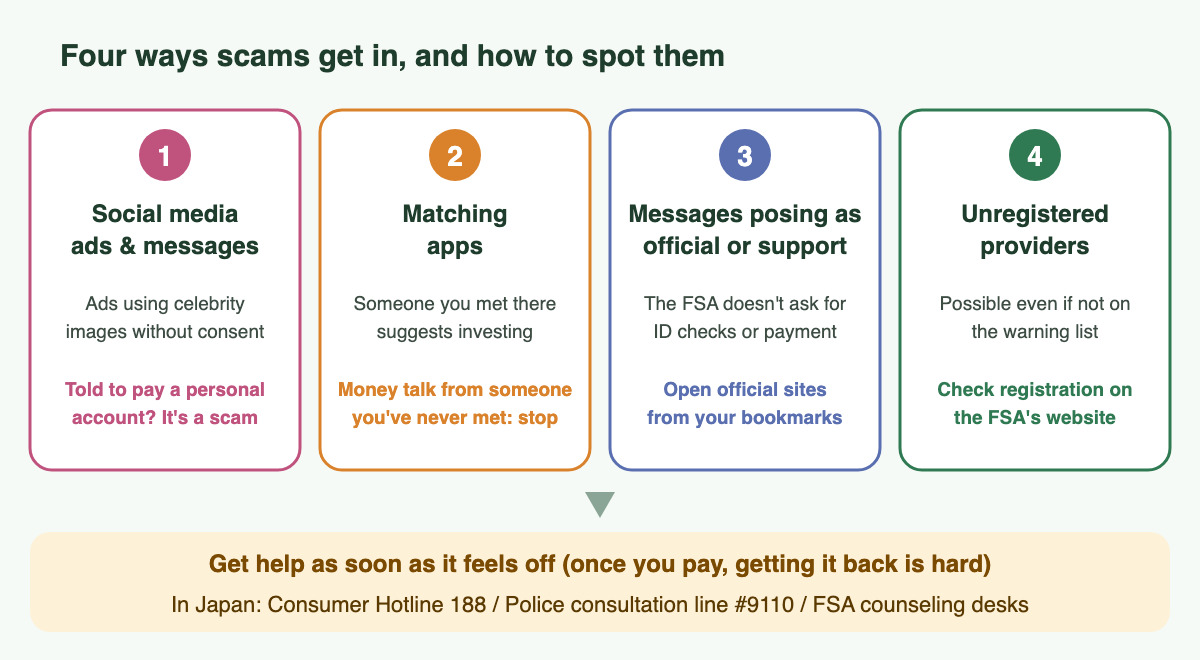
Here's a summary of common patterns and where to get help, based on warnings from the National Police Agency, the National Consumer Affairs Center of Japan (a government-affiliated consumer protection body), the Financial Services Agency (FSA, Japan's financial regulator), and the Consumer Affairs Agency. First, the whole picture as a diagram.
Let's start with the numbers.
According to the National Consumer Affairs Center, crypto asset consultations registered in PIO-NET (Japan's national database of consumer consultations) were 8,498 in FY2023, 7,261 in FY2024, and 8,132 in FY2025. For FY2026, there were 656 as of May 31 (827 in the same period the year before).
These figures don't include consultations about in-game currency used to buy items in online games.
In the National Police Agency's preliminary figures, the "crypto-sending type" of social media romance scam, where victims are made to send crypto assets, accounted for 2,148 cases and about 24.63 billion yen in losses.
Adding the bank-transfer cases where the payment was made in crypto, scams where money was effectively handed over as crypto made up 40.2% of romance scam cases and 47.9% of the losses.
Numbers alone can make it feel far away, but the way in is the social media and apps we use every day (the sheer size of these counts made me stop reading for a second).
Pattern 1: Investment pitches from social media ads and messages
According to the National Police Agency, first contact in social media investment scams came through banner and other ads in 3,760 cases and direct messages in 3,576 cases, with those two making up about 80% of the total.
Some ads used celebrities' images or videos without permission, and some included phrases like "guaranteed profits" and "principal guaranteed."
A warning the National Consumer Affairs Center published on September 1, 2026 describes cases where people are drawn from an ad using a celebrity's name into a group on a messaging app, and are at first shown what look like profits. When they try to withdraw, they're told to pay large fees or "taxes" first.
The same warning says that if you're told to send your investment money to an account in an individual's name, it's a scam, so don't pay.
It also recommends checking the celebrity's official website or official accounts for warnings about impersonation.
Pattern 2: Romance scams that start on matching apps
The National Consumer Affairs Center's consultation cases include people who were encouraged to invest in crypto by someone they met on a matching app, and then were told to pay tax when they tried to withdraw.
A joint warning from the Financial Services Agency, the Consumer Affairs Agency, and the National Police Agency also lists, as a typical case, being encouraged to invest by someone met on a dating site or matching app, then not getting the money back or losing contact.
The National Consumer Affairs Center has also published a checklist for this pattern titled "'Invest because I love you'? Isn't that strange!?"
If money comes up with someone you've never met in person, that seems like a fine signal to stop right there (the title just says it straight out, which is weirdly calming).
Pattern 3: Messages claiming to be official or support
The Financial Services Agency warns about emails that pose as the FSA and ask for identity checks, and videos in which people claiming to be FSA staff recommend investments.
It explains that the FSA never directly asks you to verify your identity or make a payment, and that its staff don't recommend investments.
The Japan Virtual and Crypto assets Exchange Association (JVCEA, the self-regulatory association for crypto exchanges in Japan) has also put out a warning about posts on X that use the names of the association or its members to claim they're handing out benefit payments.
In another warning, noting a rise in cases where IDs and passwords are stolen through fake sites and fake apps posing as real companies, it lists the following.
- If multi-factor authentication is available, always set it up
- Don't reuse passwords, and make them hard to guess
- Open official sites from your bookmarks
- Don't open links in emails or SMS, even from senders you recognize
The National Consumer Affairs Center also warns about secondary scams that approach you promising to recover your losses.
The more a message claims to be support or relief, the safer it is to check with an official contact you've looked up yourself (showing up looking like help is the sneakiest part).
Pattern 4: Providers that aren't registered
To run a crypto asset exchange business for residents of Japan, registration under the law is required. The FSA publishes a list of registered providers and the names of providers it has sent warning letters to for operating without registration.
According to the FSA, it gets many reports about dealings with unregistered providers: withdrawals of deposited money being refused, outrageous fees being demanded, or suddenly losing all contact.
The FSA cautions that a provider may be operating without registration even if its name isn't on the list of warned providers. When you hear a provider's name, the first step is to check on the FSA's website whether it's registered.
Where to get help in Japan
These are the contacts listed in materials from the National Police Agency, the National Consumer Affairs Center, the Financial Services Agency, and the Consumer Affairs Agency. Hours are as stated in those materials.
- Consumer Hotline: 188, no area code needed (connects you to your nearest consumer affairs center or similar office)
- Police consultation line: #9110 (for trouble that looks like fraud, go to your nearest police station)
- FSA Counseling Office for Financial Services Users: 0570-016811 (weekdays 10:00–17:00; from IP phones, 03-5251-6811)
- FSA "Consultation Line for Fraudulent Investments": 0570-050588 (weekdays 10:00–17:00; from IP phones, 03-6206-6066)
- Japan Virtual and Crypto assets Exchange Association: 03-3222-1061
The National Consumer Affairs Center says that once you've paid, it's hard to recover your losses, and urges you to get help as soon as something seems suspicious.
About this article
This article is based on materials published by the National Police Agency, the National Consumer Affairs Center of Japan, the Financial Services Agency, the Consumer Affairs Agency, and the Japan Virtual and Crypto assets Exchange Association. Counts are as of when they were published, and the National Police Agency's 2025 figures are preliminary.
Phone numbers and hours for the contacts can change, so please check each organization's page before calling.
This article is not a recommendation to buy or sell crypto assets. For decisions about individual losses or contracts, please consult the contacts above or a professional such as a lawyer.
Quotes from Japanese sources are our own translations.
Translated from the Japanese original.
See you next time on COT❣️