
GM, COT❣️ Yuzunoko here.
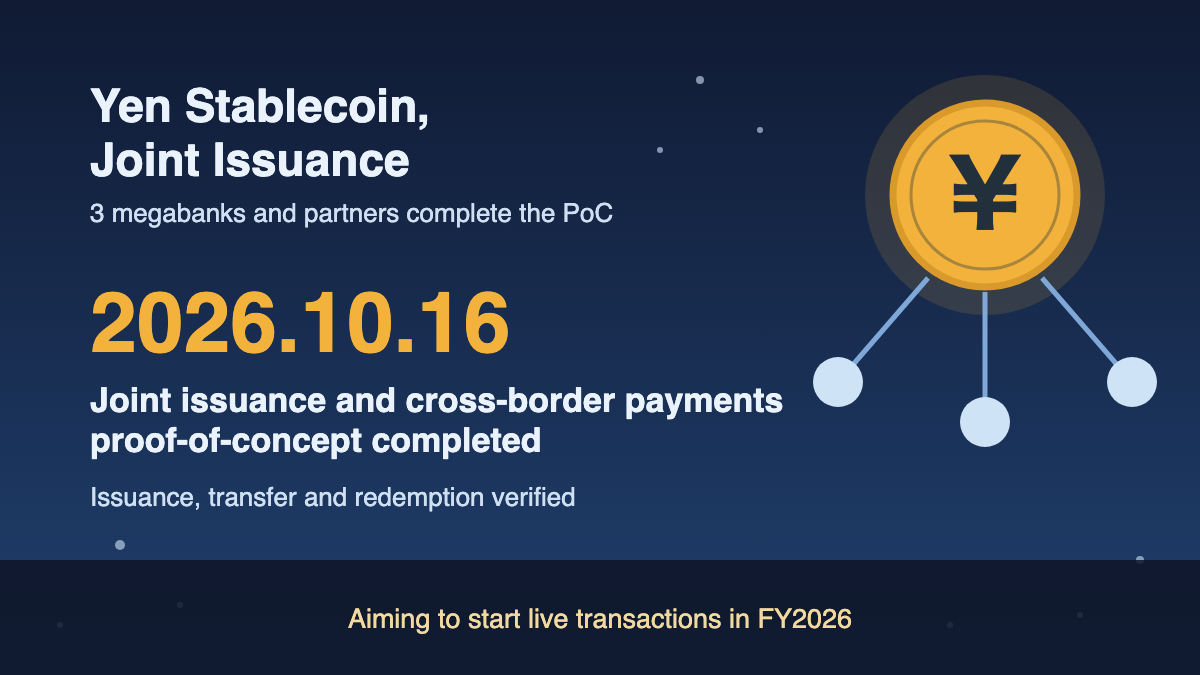
Did you know that Japan's three megabanks have completed a proof-of-concept trial for jointly issuing a yen-denominated stablecoin?
On October 16, 2026, five companies announced the news: Mizuho Bank, MUFG Bank and Sumitomo Mitsui Banking Corporation (SMBC) — the three megabanks — plus Mitsubishi UFJ Trust and Banking Corporation and TISI. They conducted a proof-of-concept (PoC) trial of a stablecoin jointly issued by multiple banks, and of cross-border payments using that coin.
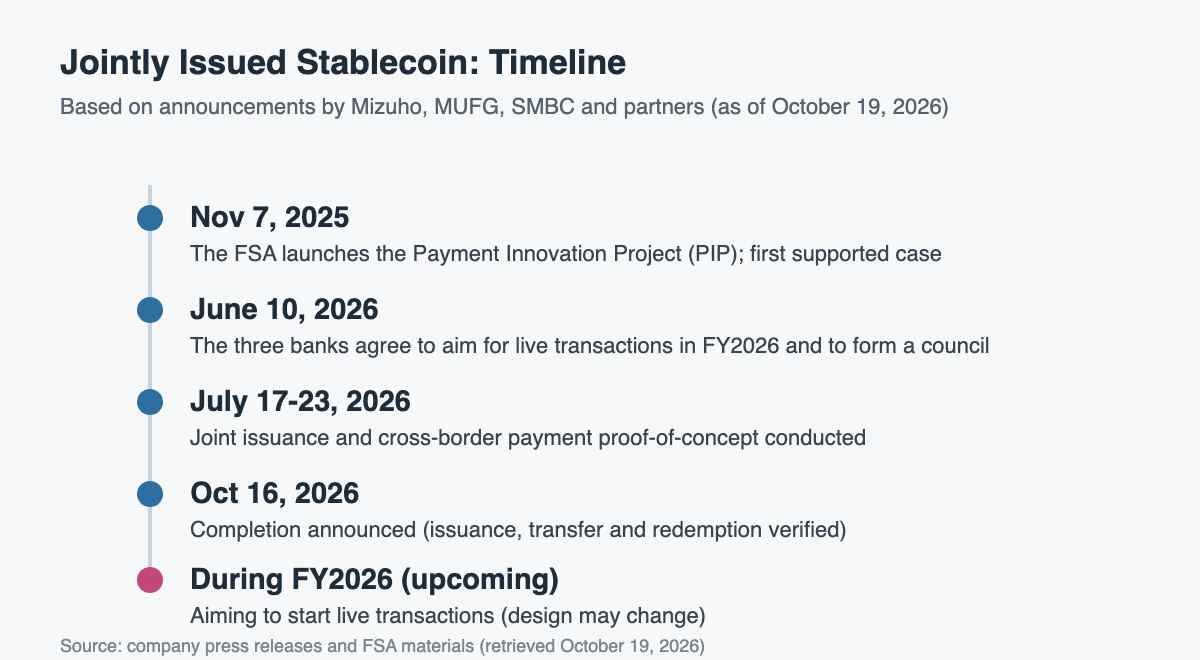
The trial ran for one week, from July 17 to 23, 2026. Simulating payments between Mitsubishi Corporation's locations in Japan and overseas, the companies verified the whole process from stablecoin issuance and transfer to redemption.
(The idea of three banks jointly issuing one coin is fascinating in itself.)
What the Proof of Concept Verified
This trial is based on an initiative selected in November 2025 for support under the Financial Services Agency's (FSA) "FinTech Proof-of-Concept Hub / Payment Innovation Project (PIP)." The FSA launched the PIP on November 7, 2025, and this joint issuance project became its first supported case.
The stablecoin was issued as "specified trust receivable rights" under Article 2, Paragraph 9 of the Payment Services Act, based on a trust agreement with the three banks as joint settlors and Mitsubishi UFJ Trust and Banking as trustee.
The main points verified were:
- Operational methods when multiple banks act as settlors
- Anti-money laundering and counter-terrorist financing (AML/CFT) measures assuming various use cases
- System effectiveness
TISI handled the issuance system and wallet infrastructure, and the blockchain platform — built by TISI under commission from Sumitomo Mitsui Banking Corporation — was provided to the companies taking part in the trial.
As for the results, the five companies said they gained practical insights into stablecoin issuance and circulation, and confirmed the system's safety and reliability and the feasibility of a multi-bank joint issuance model.
What Is a Trust-Based Stablecoin?
The coin issued in this trial uses what is called a "trust-based" framework. In an explanatory document published by the FSA for the 2025 revision of the Payment Services Act, the trust-based structure is shown as one where a trust bank is the issuer, holding backing assets (trust assets) equal to the issued amount, with the coin's value linked to a legal currency and redeemed at face value (1 coin = 1 yen for yen-denominated coins).
In their announcement, the five companies described the features this way:
- Circulability and convenience: Joint issuance by multiple banks secures broad circulation based on each bank's customer base. Anticipating large-scale circulation, the scheme adopts a trust-based issuance model with no cap on circulation volume.
- Safety and reliability: With a focus on the stability of the coin's value, trust assets are invested and managed in bank deposits. Circulation is among trusted users who have completed identity verification and other procedures at banks.
("Trust" may sound like heavy legal jargon, but it means a trust bank safeguards the money backing the coins.)
Stablecoins are described in FSA materials as "so-called stablecoins (electronic payment instruments)," and are legally distinct from "crypto assets" such as Bitcoin. Under the FSA's framework, regulation of crypto assets is being moved from the Payment Services Act to the Financial Instruments and Exchange Act, while stablecoins remain under the Payment Services Act. These differences are summarized in JPYC basics: the Japanese yen stablecoin is an "electronic payment instrument," and how that differs from crypto assets.
Upcoming Plans
On June 10, 2026, the three banks announced that they aim to start live transactions of the jointly issued stablecoin within fiscal year 2026, and that they had reached a basic agreement to establish a council for examining operations and governance. This trial was the validation step before that.
The design planned for practical use assumes deposits as backing assets, with circulation among users who have completed identity verification and other procedures at banks. The focus is on meeting payment and remittance needs. This is the current assumption, and it may change in the future, the companies said.
The financial institutions are also working on other initiatives, such as a proof of concept for trading and transferring rights to traditional assets using blockchain and digital money (announced February 13, 2026) and a proof of concept for trade settlements using the "TradeWaltz" trade platform (announced September 29, 2026). They say they aim to help bring on-chain finance into practical use, including putting deposits and other financial assets on-chain.
(Faster international remittances could matter for people traveling to events overseas, too.)
About This Article
This article was compiled from the five companies' announcement of October 16, 2026, the three banks' announcement of June 10, 2026, and public materials from the Financial Services Agency. Numbers and dates were checked against those announcements and FSA documents.
The timing and design of live transactions may change as discussions continue. For the latest information, please check announcements from each bank and the FSA.
This article is not a recommendation to use, buy or sell stablecoins or crypto assets. It summarizes what has been announced and what is planned.
Quotes from Japanese sources are our own translations.
Translated from the Japanese original.
See you next time on COT❣️