
GM, COT❣️ Yuzunoko here.
When sewing hook-and-loop fasteners onto costumes, do you also check whether there is adhesive on the back?
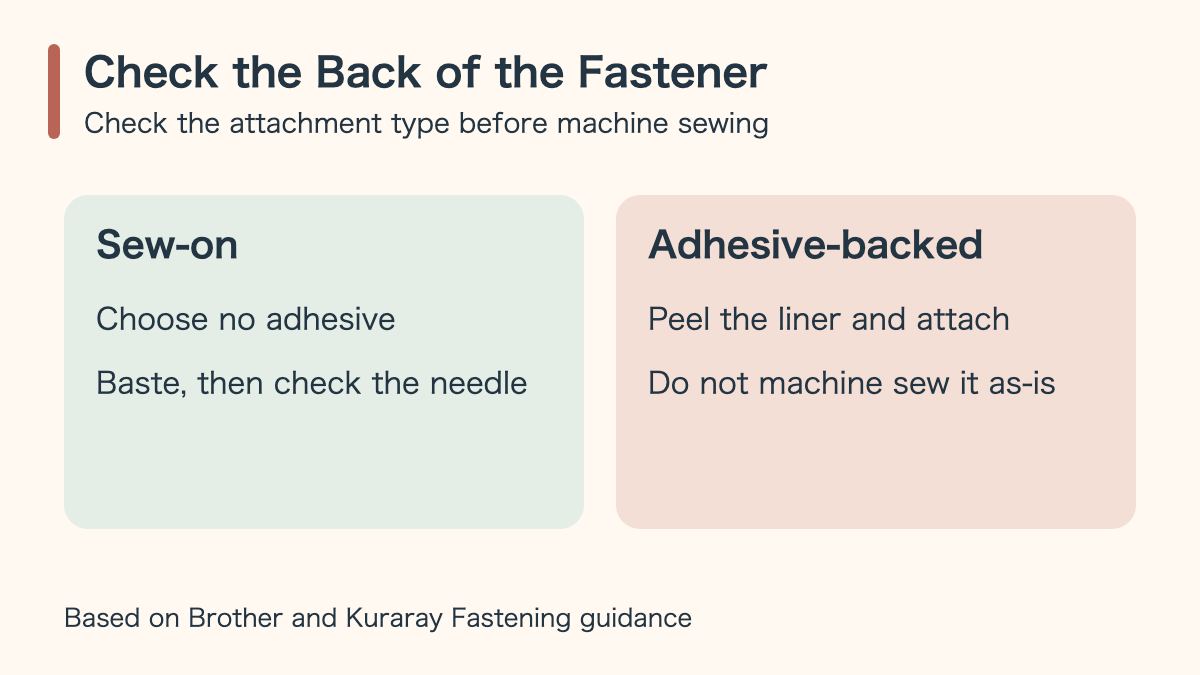
Aligning the fastener, sticking it on, and sewing over it with a sewing machine might seem like a great way to prevent slipping. However, Brother's guidance for home sewing machines instructs users to use sew-on fasteners without adhesive.
When choosing fasteners for cosplay costumes, it is worth checking not only the fastening surface on the front, but also how they attach to fabric.
Do Not Run Stick-on Types Straight Through a Sewing Machine
According to Brother's "Sewing Hook-and-Loop Fasteners (Magic Tape®)," using adhesive-backed hook-and-loop fasteners causes glue to adhere to the needle and hook/shuttle mechanism, which can lead to machine malfunctions.
The guidance advises selecting non-adhesive sew-on fasteners if you plan to sew them with a sewing machine. "Temporarily sticking and then sewing" is not a method recommended by the company.
(Once it is positioned, it is tempting to just sew right over it, though.)
Kuraray Fastening's attachment methods page also explains sew-on, adhesive, and welding methods separately. Adhesive types are meant to be applied by peeling off the release paper on the back. Even if they look similar on the surface, their attachment methods are not necessarily the same.
Note that "hook-and-loop fastener" is a generic term, while "Magic Tape®" is a registered trademark of Kuraray. This article uses the generic term.
Baste and Check If the Needle Passes Through
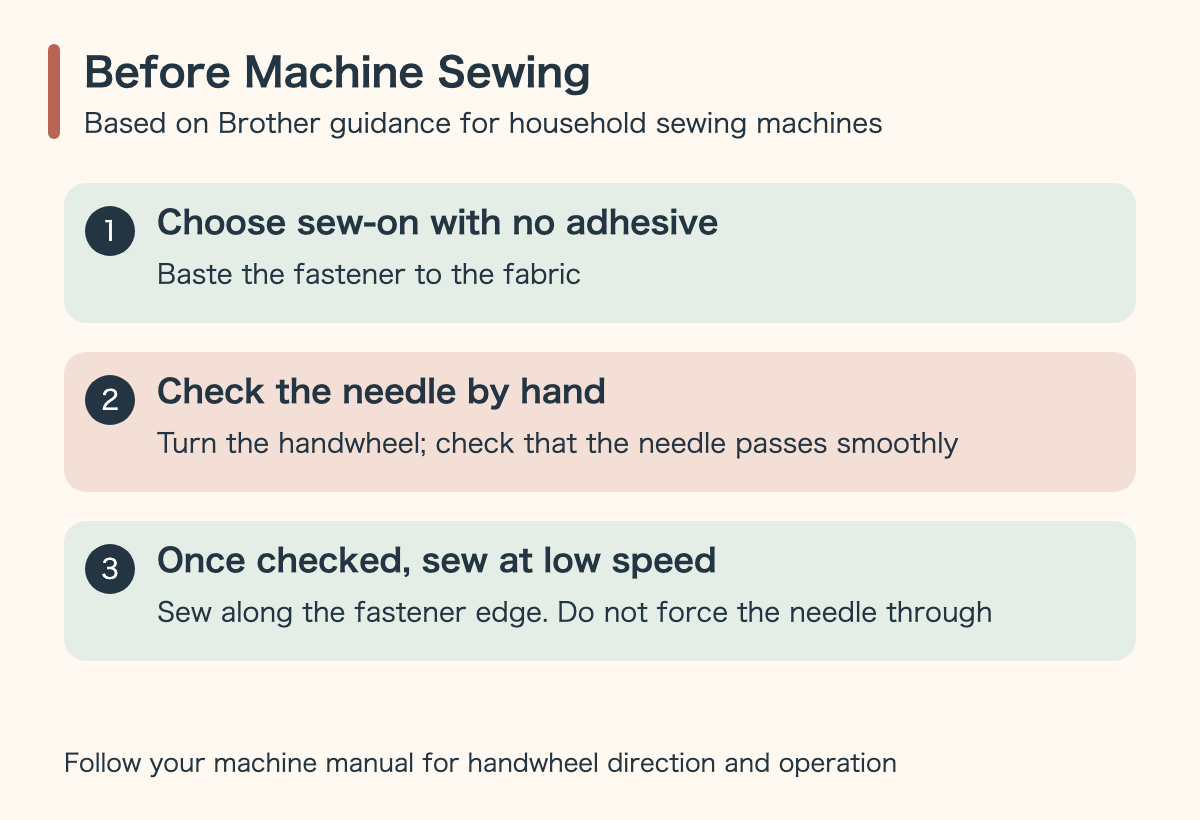
Brother advises basting the hook-and-loop fastener and fabric together before sewing with a machine.
After that, turn the handwheel by hand to insert the needle and check whether it passes through smoothly. The procedure is to confirm that it penetrates smoothly before sewing along the edge of the fastener at low speed. The pulley is the sewing machine's handwheel.
The same FAQ notes that sewing hook-and-loop fasteners with fine needle sizes (#9 to #11) risks bending or breaking the needle. If the needle does not pass through, the explanation instructs replacing it with a needle and thread designed for heavy-weight fabrics.
However, this does not mean that using a thicker needle allows sewing through any layered combination. Please check your sewing machine's manual for appropriate combinations of fabric, thread, and needles, as well as the correct direction to turn the handwheel. Forcing the wheel to push the needle through is not recommended.
For cosplay costumes, I suggest testing on scraps of the same fabric and fastener before sewing the actual costume piece. In addition to checking whether the color matches the fabric, you will want to make sure the needle can pass through the layered materials.
For Adhesive Types, Also Check Compatibility with Application Materials
Even when choosing stick-on options that do not require sewing, it is best not to assume they will stick to anything just because the packaging says "heavy-duty" or "strong."
Kuraray Fastening does not recommend using its adhesive-backed products on soft PVC (flexible vinyl). The explanation states that plasticizers contained in soft PVC react with the adhesive, reducing bond strength.
The company's FAQ also mentions that there are materials to which fasteners cannot adhere, such as water-repellent-treated products, fluorine-treated products, and silicone products. It states that thorough advance testing is required under the actual conditions of use.
If you are sticking them onto costumes or props, start by checking the compatible materials indicated for the tape alongside the material composition and surface finish of the fabric or components you are sticking it to. This helps avoid treating materials that look similar as identical.
The editorial suggestion from this article is to verify whether it can hold detachable decorations beforehand using the exact same attachment method as the final build. The necessary tape area and the weight it can support cannot be determined uniformly. Kuraray Fastening also states that attachment strength varies depending on the method, the condition of the materials, and the operating environment.
When Washing, Fasten Closed and Use a Laundry Net: But Check Overall Costume Care Labels First
According to Kuraray Fastening's FAQ, its products attached by sewing can be washed and dry-cleaned.
For home washing machines, it advises placing the garment in a laundry net with hooks and loops fastened closed. This prevents damage to other laundry items and makes it harder for lint and debris to cling to the fastener.
On the other hand, certain products may shrink depending on washing conditions, and adhesive-backed items may not withstand laundering. The manufacturer advises testing beforehand under actual conditions of use.
This does not mean that the entire costume is washable just because hook-and-loop fasteners are attached. Please check the care labels and individual product instructions for the whole costume first, including the fabric, trims, and bonded areas.
(After all, just because the fastener alone can be washed does not mean delicate decorations can handle it too.)
Care labels for the entire costume are covered in Before Washing Cosplay Costumes: Reading Laundry Care Labels for Temperature, Hand-Washing, Drying, and Decorative Trim Warnings.
About This Article
Translated from the Japanese original.
This article was compiled based on official guidance from Brother and Kuraray Fastening. Please check the specified methods and compatible materials for each sewing machine model and hook-and-loop fastener product. It does not guarantee sewing feasibility, adhesive strength, or washability for any specific costume.
Once you have decided on the placement for your cute decorations, take a glance at the back before sewing. Start by confirming whether adhesive is present❣️
See you next time on COT❣️
Sources: Sewing Hook-and-Loop Fasteners (Magic Tape®) (Brother) (Japanese), Attachment Methods to Products (Kuraray Fastening) (Japanese), Frequently Asked Questions (Kuraray Fastening) (Japanese)