
GM, COT❣️ Yuzunoko here.
Have you seen people saying crypto tax in Japan "is 20% now" and others saying "it's still aggregate taxation," and wondered which one is right?
The answer is that each is only partly right. A 20% separate taxation was set by law in March 2026.
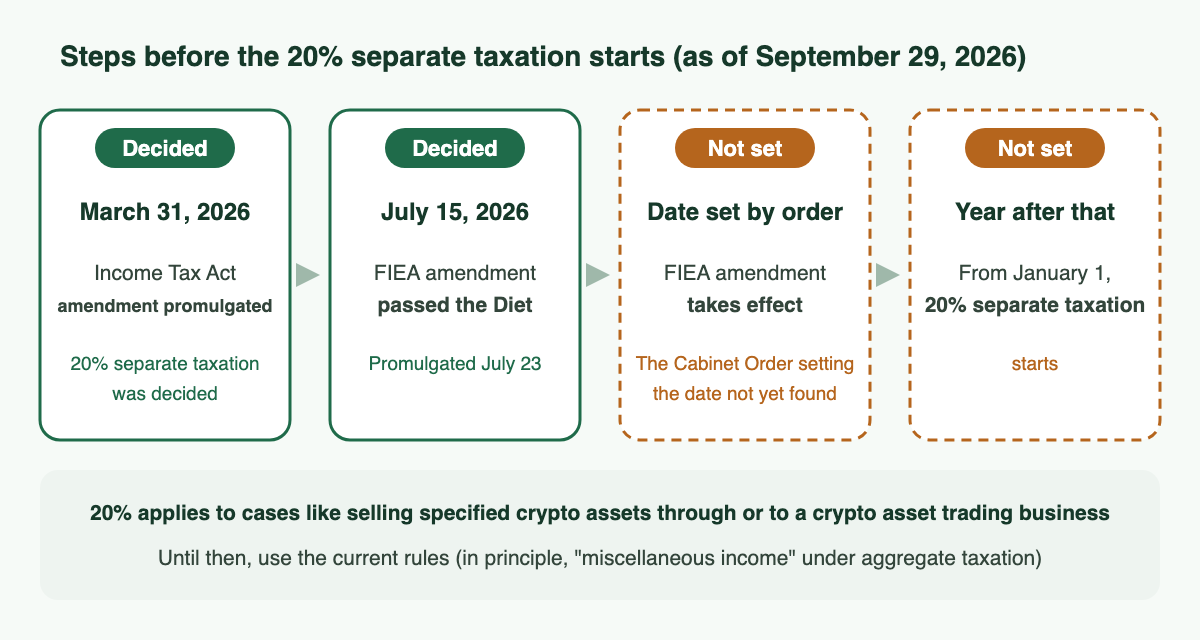
But it starts only from the year after a different law, which it depends on, takes effect, and that effective date hasn't been decided yet. So for the current year, you calculate things the same way as before.
How it works now: "miscellaneous income" in principle
According to the FAQ from the National Tax Agency (Japan's tax authority), profits from crypto asset transactions are subject to income tax and are, in principle, classified as miscellaneous income (other miscellaneous income). Miscellaneous income falls under aggregate taxation, where the tax is calculated together with your other income, like your salary.
There are exceptions. If your revenue from crypto transactions in a year exceeds 3 million yen, it's in principle business income if you keep books and records, and in principle business-related miscellaneous income if you don't. Even with books, the FAQ says cases where there's no profit motive, for example, are judged individually.
Another important point is how losses are handled. Losses in miscellaneous income can't be deducted from other income, such as salary income. The FAQ explains that the only losses you can offset against other income are those from real estate income, business income, forestry income, and capital gains income.
Tax can apply at times other than "when you sell"
It's easy to assume only converting to yen counts, but the FAQ also lists situations like these.
- When you buy goods with crypto assets (this counts as transferring the crypto you hold)
- When you swap one crypto asset for another
- When you receive crypto assets from mining, staking, lending, and so on (the market value at the time you receive them counts as income)
- Crypto margin trading (not eligible for separate taxation; it's under aggregate taxation)
The acquisition cost your calculation is based on is worked out with either the total average method or the moving average method. If you haven't filed a notice choosing a valuation method, it's the total average method.
If you use a crypto asset exchange service provider in Japan, you'll get an "annual transaction report," and apparently entering it into the National Tax Agency's "crypto asset calculation sheet" makes the math easier (keeping records of your transactions, no matter what, seems to be the real shortcut here).
The same FAQ also says that crypto assets received through inheritance or as a gift are subject to inheritance tax or gift tax, and that people who submit a statement of assets and liabilities should include the crypto assets they hold as of December 31.
What the law has settled: 20% separate taxation for specified crypto assets
On March 31, 2026, the Act Partially Amending the Income Tax Act, etc. (Act No. 12 of 2026) was promulgated. According to the National Tax Agency's overview, the main points are as follows.
- It covers "specified crypto assets" (certain crypto assets registered in the register of financial instruments business operators, and so on)
- It applies to selling through a crypto asset trading business on consignment, or transferring to a crypto asset trading business
- The tax rate is 20% (15% income tax and 5% individual inhabitant tax), under separate taxation with a tax return
- Losses that can't be fully deducted can, under certain conditions, be carried forward for the following 3 years
In other words, it's not the case that any crypto asset sold anywhere becomes 20%. There are conditions on both the asset and who you're trading with.
The same reform also changes how income from transferring crypto assets is categorized. According to the National Tax Agency's overview, except for transfers made continuously for profit, income from transferring crypto assets will be calculated as "capital gains income" under aggregate taxation, and those losses won't be offset against other income under aggregate taxation (this starts at the same time as the separate taxation).
Figuring out which of these your own trades fall into is probably the most confusing part (the names are so alike that just comparing them makes my head spin).
What hasn't been decided: when it starts
The National Tax Agency's overview says it applies from January 1 of the year after the year in which the Act Partially Amending the Financial Instruments and Exchange Act and the Payment Services Act (the FIEA amendment) takes effect. That law passed the Diet (Japan's parliament) on July 15, 2026, and was promulgated on July 23 as Act No. 64 of 2026.
However, the core part, which moves crypto asset regulation under a different framework, takes effect "on a date set by Cabinet Order within a period not exceeding one year from the date of promulgation." As of September 29, 2026, the Cabinet Order setting that date couldn't be confirmed in the Financial Services Agency's published materials.
So the order is: once the year it takes effect is set, the year the new tax starts is set too. As a diagram, it looks like this.
As for things still under consideration, the Financial Services Agency's FY2027 tax reform requests, compiled in August 2026, include measures for trust-type stablecoins (specified trust beneficiary rights). This is only at the request stage, not a decided rule.
About this article
This article is based on the National Tax Agency's crypto asset FAQ, the National Tax Agency's overview of the FY2026 amendments, the Financial Services Agency's page on bills submitted to the Diet and its tax reform requests, and the amendment history on e-Gov Law Search (Japan's official database of laws).
The year the 20% separate taxation starts will be set once the Cabinet Order fixing the amendment's effective date is issued. Before filing a tax return, please check the National Tax Agency's latest FAQ and announcements.
How tax applies depends on your transactions and your income situation. For decisions about your own case, please consult a licensed tax accountant or your local tax office in Japan. This article is meant to help you understand the system, and it is not a recommendation to buy or sell crypto assets.
Quotes from Japanese sources are our own translations.
Translated from the Japanese original.
See you next time on COT❣️