
GM, COT❣️ Yuzunoko here.
Have you ever tried to send crypto, been asked for the recipient's name and why you're sending it, and felt a little on guard?
That's what's called the "Travel Rule." As the Japan Virtual and Crypto assets Exchange Association (JVCEA, the self-regulatory association for crypto exchanges in Japan) explains it, the Travel Rule means a provider that sends crypto assets on a user's behalf has to notify the receiving provider of set information about the sender and the recipient.
According to materials from the Financial Services Agency (FSA, Japan's financial regulator), it has been in force as law in Japan since June 1, 2023. The goal is to make it possible to trace the path of crypto transactions.
It started as an international anti-money-laundering standard
According to JVCEA, the Travel Rule is a standard that the FATF (Financial Action Task Force) asks authorities in each country to adopt as a measure against money laundering and terrorist financing. The aim, it says, is to stop terrorists and criminals from freely moving money electronically, and to make it traceable when it's misused.
As JVCEA explains, in the FATF's fourth-round mutual evaluation of Japan, Japan was told to cover not only wire transfers but also crypto asset transfers under this rule.
The name sounds like travel, but what's inside is a very serious system (hearing just the name, I half expected packing rules for a trip).
When it started in Japan
It started in two stages. First, at the FSA's request, JVCEA brought in the Travel Rule through the association's self-regulatory rules, ahead of the law. That was from April 1, 2022.
There were transitional measures during this period. Notification only applied when you sent Bitcoin or Ethereum to yourself, at a domestic exchange, worth more than the equivalent of 100,000 yen.
From October 1, 2022, information about the recipient's address and information such as the purpose of the transfer also started being checked. According to JVCEA's notice, the address information is basically the country and region (state or prefecture).
On the legal side, the Act on Prevention of Transfer of Criminal Proceeds (Japan's anti-money-laundering law), amended in December 2022, set out provisions imposing a notification obligation on crypto asset transfers. According to the FSA, it has been in force since June 1, 2023, together with the related cabinet orders.
The overview of the act published by JAFIC, the National Police Agency's office for preventing the transfer of criminal proceeds, also states that crypto asset exchange service providers must notify information about the customer and the counterparty when they transfer crypto assets.
What gets passed between providers
According to the FSA's explanatory material, the sending provider notifies the receiving provider of the following.
- Sender: name, home address or customer ID number, blockchain address
- Recipient: name, blockchain address
- For a company: its corporate name instead of a name, and the location of its head office or similar instead of a home address
Here's the flow as a diagram.
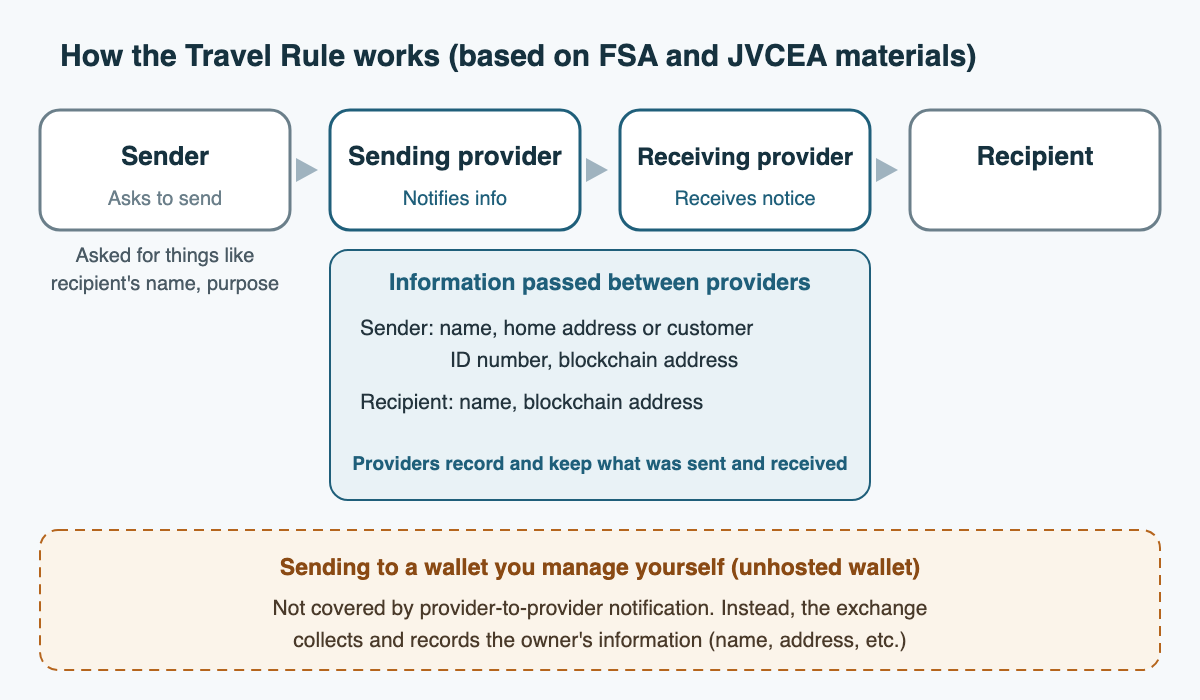
For the blockchain address, either the address itself or a number that can identify the address is allowed. Providers have a duty to record and keep what they notified and what they were notified of.
It covers transfers to domestic providers and to foreign providers, and every transfer is covered regardless of the amount or the type of crypto asset.
Transfers to countries and regions without notification rules similar to Japan's are left out. The amendment to the notice that the FSA published in July 2026 added 5 jurisdictions to the previous 58, and it has applied since August 3.
What happens on the sender's side
JVCEA's notice for users explains that when you ask an exchange to send crypto, you'll be asked to state the recipient's name, whether there is an exchange on the receiving side, and if so, its name. For the purpose of sending, it gives examples of choosing from options such as using an exchange's services, paying for goods in Japan, or gifts for inheritance or living expenses.
In the explanation of the self-regulation that started in 2022, if a user doesn't consent to notification for a transfer that falls under it, the exchange can't make that transfer.
In a 2023 notice, JVCEA also says that which providers can be notified differs from exchange to exchange, and asks users to check each company's notices.
The quickest route is to read your exchange's guidance before you send (skip that part, and I suspect you'll be stuck staring at the send screen).
When you send to a wallet you manage yourself
A wallet that users manage themselves is called an "unhosted wallet," meaning a wallet that no provider manages. According to JVCEA, transfers to unhosted wallets or to wallets at unregistered providers are not covered by provider-to-provider notification.
Instead, according to the FSA's material, exchanges are required to collect and record information about the owner of the receiving unhosted wallet or similar (such as name and blockchain address), look into who they are, and assess the money laundering risk. So even when you send to your own wallet, you may be asked about the owner.
About this article
This article is based on the FSA's press releases and explanatory material, JVCEA's notices for users, and the overview of the Act on Prevention of Transfer of Criminal Proceeds published by Japan's National Police Agency. The countries and regions covered change with amendments to the notice, and which counterparties can be notified and what you're asked differ by exchange. Before you send, check the FSA's latest materials and your exchange's guidance.
This article is not a recommendation to buy or sell crypto assets. For individual transactions or legal questions, please check with your exchange's support desk or a professional.
Quotes from Japanese sources are our own translations.
Translated from the Japanese original.
See you next time on COT❣️