
GM, COT❣️ Yuzunoko here.
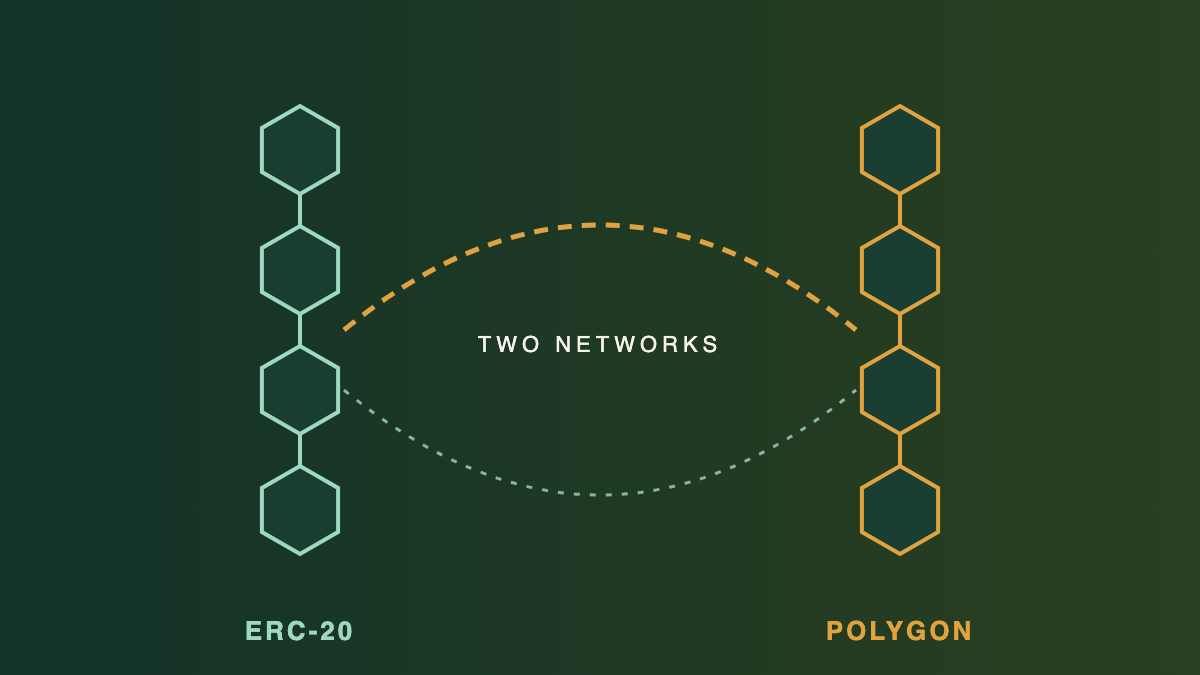
Those two lines in the COT whitepaper, "ERC-20" and "Polygon": could you explain what they mean?
The token specs in the official whitepaper list two contract addresses. One is for ERC-20 on Ethereum, and the other is for Polygon.
So even though they share the name COT, they live on separate blockchains.
The two addresses in the whitepaper
The token specs section of the whitepaper lists them like this.
- ERC-20: 0x5cac718a3ae330d361e39244bf9e67ab17514ce8
- Polygon: 0x8d520c8E66091cfD6743fe37Fbe3A09505616C4b
In the same document's glossary, ERC-20 is described as "a technical standard used for smart contracts on the Ethereum blockchain, representing what are called tokens," and Polygon as "a blockchain network compatible with Ethereum."
On the other hand, the whitepaper doesn't say how these two contracts relate to each other, for example which one you can move tokens to from the other. You can't tell that from the document, so I'm not going to guess about it in this article either.
ERC-20 is a shared rulebook for "same-shaped" tokens
According to ethereum.org's explanation, ERC-20 is a standard for fungible tokens, meaning tokens where each one has the same value and properties. It was proposed by Fabian Vogelsteller in November 2015.
What the standard sets out are the basic functions: sending tokens to another account, checking a balance, checking the total supply, and approving a third-party account to spend a certain amount. Since the shape is fixed, wallets and apps can handle every token the same way without building something separate for each one.
The name sounds stiff, but really it's just the name of a shared rulebook that says "build it like this, and everyone can handle it the same way" (I love how the standard's number just became its name. That's so very tech-world).
Polygon is a separate chain connected to Ethereum
Polygon's official documentation describes Polygon Chain as an EVM-compatible blockchain anchored to Ethereum. Transactions run outside Ethereum Mainnet, and through a mechanism called checkpoints, it regularly records its state to Ethereum.
The name differs depending on the source: the COT whitepaper calls it "Polygon / Matic Network."
ethereum.org describes a blockchain that runs independently from Ethereum and connects to Ethereum Mainnet through a two-way bridge as a sidechain, and says EVM-compatible sidechains can run contracts developed for Ethereum. Polygon's official documentation also says contracts that run on Ethereum can be deployed to Polygon without changing the code.
What you pay transaction fees (gas) with is different too. According to ethereum.org, Ethereum gas is paid in ETH, and according to Polygon's official documentation, POL is the token used for gas and staking on Polygon Chain.
So even in the same wallet app, what you need for fees changes depending on which network you've selected.
"Bridges" for crossing between chains
According to ethereum.org, each blockchain runs on its own rules and mechanisms, and tokens can't move freely between chains as they are. That's where bridges come in.
The sidechain explanation says assets don't physically move between the two chains; value is usually moved through a mechanism involving minting (issuing) and burning (destroying).
The explanation of Polygon's official bridge, "Polygon Portal," follows the same pattern.
When you deposit from Ethereum, the tokens on the Ethereum side are locked, and the same number of tokens are issued 1:1 on the Polygon Chain side. When you move them back to Ethereum, they're burned on the Polygon Chain side and unlocked on the Ethereum side.
Here it is as a diagram.
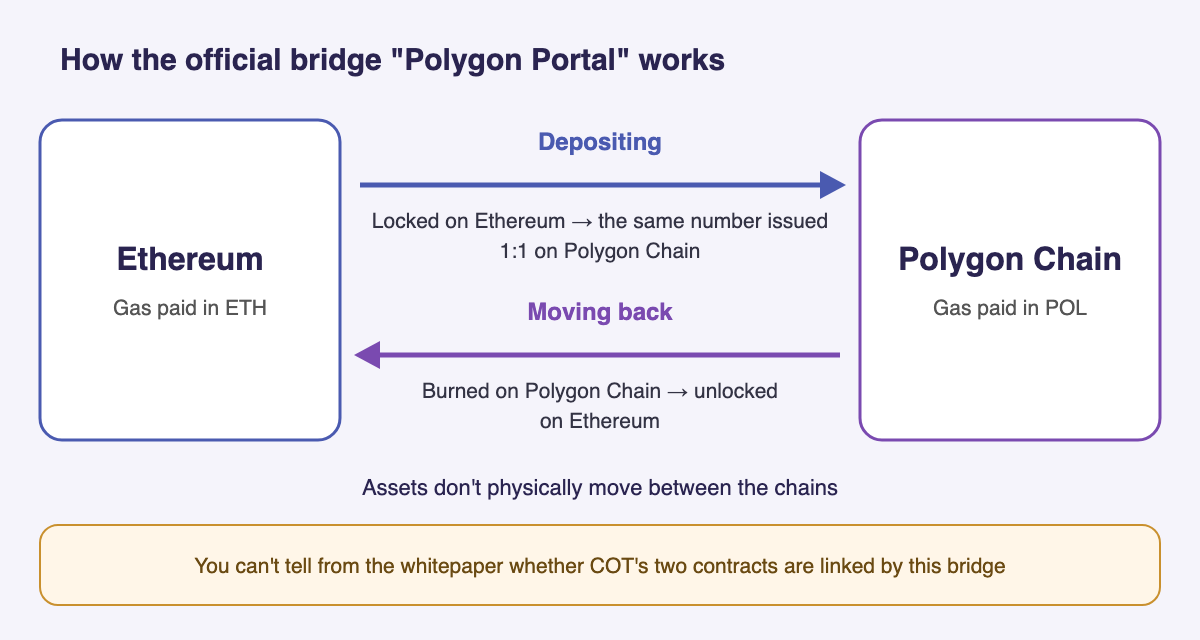
Whether COT's two contracts are linked by this official bridge is something you can't tell from the whitepaper. Please read this as a general explanation of how bridges work.
What to check before you send
A report from a survey commissioned by Japan's Digital Agency (the government agency in charge of digital policy) lists, as typical user errors, sending to the wrong address or choosing the wrong network, which makes recovery difficult. ethereum.org also says that transactions can't be reversed, so check everything three times.
- Network: are the sender and the recipient using the same chain (Ethereum or Polygon)?
- Destination: have you checked the recipient's address character by character?
- Make sure you're not sending to a contract address
The third one is a surprise. ethereum.org explains that tokens sent to a smart contract that isn't built to handle ERC-20 tokens may be lost forever. Apparently that's because ERC-20 has no way to let the receiving contract know the tokens have arrived.
The addresses in the whitepaper are the locations of the token contracts, so they're not something you put in as a destination.
Polygon's official documentation also says, in its explanation of POL, to always verify contract addresses through official sources (when 40 letters and numbers are lined up in a row, my eyes just slide right off).
About this article
This article is based on COT's official whitepaper, ethereum.org's explanations (ERC-20, sidechains, bridges, gas and wallets), Polygon's official documentation, and a report from a survey commissioned by Japan's Digital Agency. For how the two contracts relate and which networks are supported, please check COT's official announcements for the latest information.
This article explains how things work, and it is not a recommendation to buy or sell crypto assets.
Quotes from Japanese sources are our own translations.
Translated from the Japanese original.
See you next time on COT❣️