
GM, COT❣️ Yuzunoko here.
You've probably heard that crypto assets are coming under Japan's securities law, but have you been wondering whether that has already started?
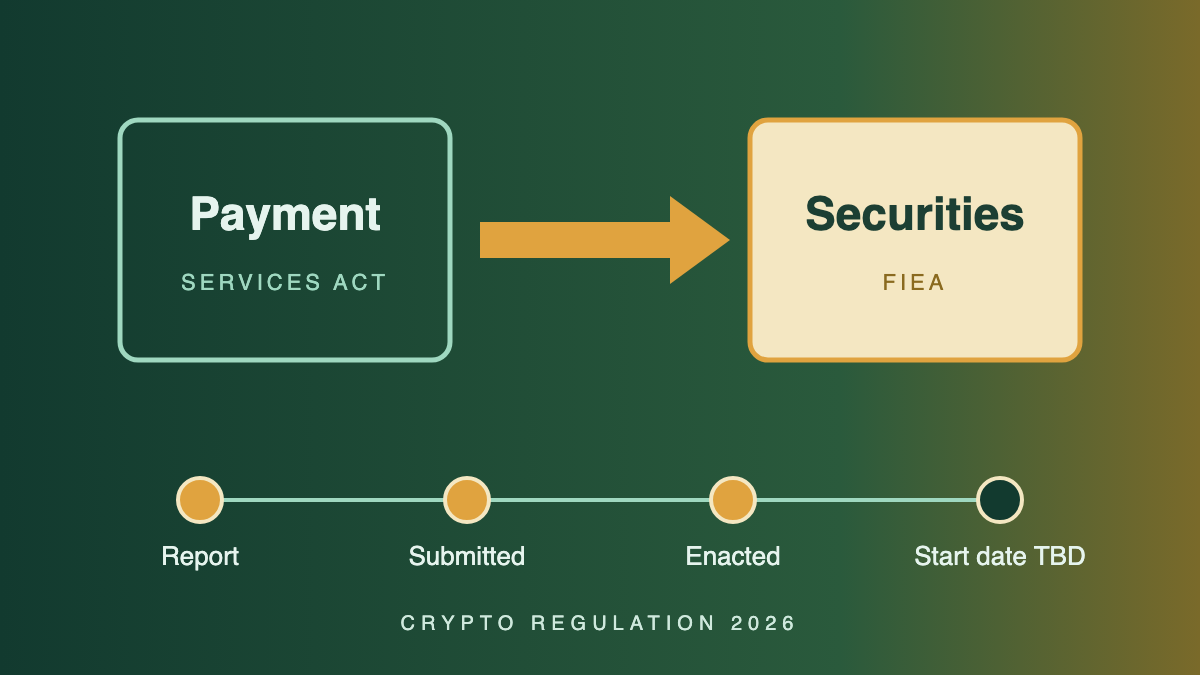
On July 15, 2026, the Diet (Japan's parliament) enacted an amendment that moves the regulation of crypto assets from the Payment Services Act to the Financial Instruments and Exchange Act (FIEA, the main law covering securities and other financial products in Japan).
But as of September 29, 2026, when the core part will start still hasn't been decided. Based on the Financial Services Agency's published materials (the FSA, Japan's financial regulator), I'll go through the stages one by one: the report, the enactment, what's already in effect, and what still has no start date.
How we got here
This is the order you can confirm in the FSA's published materials.
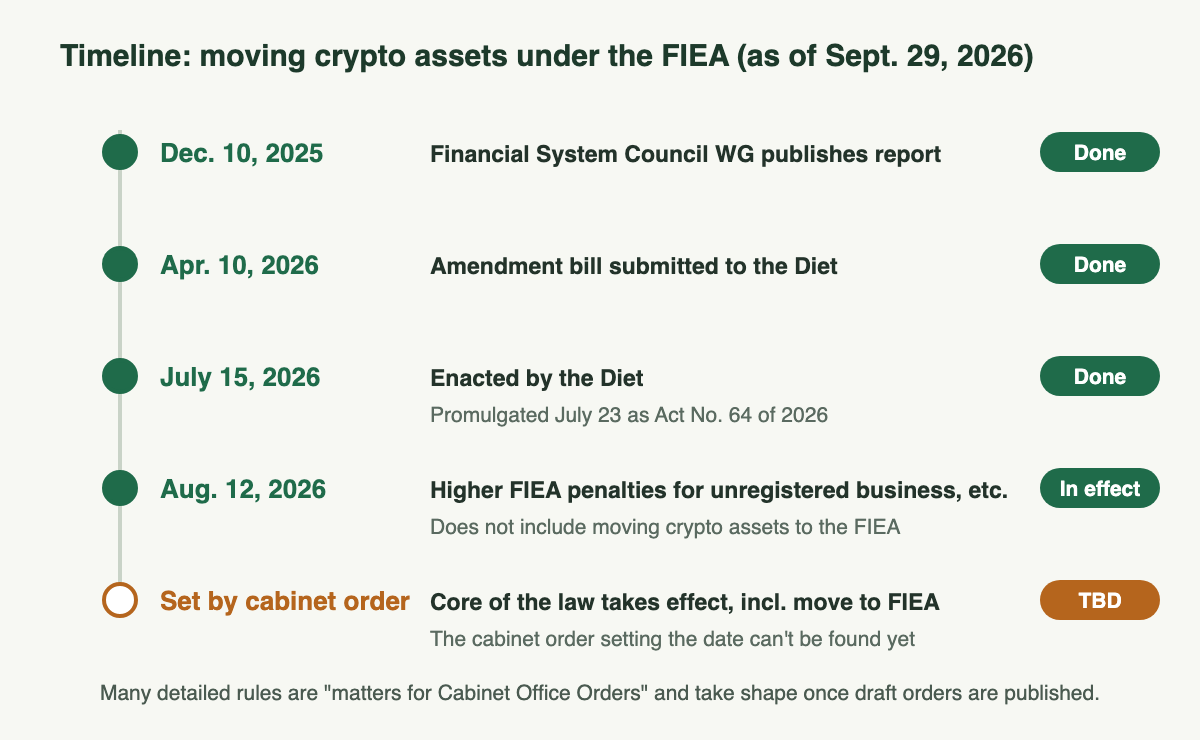
- December 10, 2025: the Financial System Council's (an advisory body to the FSA) "Working Group on the Crypto Asset System" publishes its report
- April 10, 2026: the "Bill Partially Amending the Financial Instruments and Exchange Act and the Payment Services Act" is submitted to the Diet
- July 15, 2026: enacted by the Diet (promulgated on July 23 as Act No. 64 of 2026)
- August 12, 2026: only some provisions take effect early
The report lays out the direction for the system, and it has no legal force on its own. What has force is the enacted law, plus the cabinet orders and Cabinet Office Orders that set things like the start date.
From the report to the law's enactment took about seven months.
What changes: from "a means of payment" to "a financial product"
According to the FSA's explanatory materials, crypto assets have so far been regulated under the Payment Services Act from the angle of being a means of payment, but these days they've become something people invest in, and that's the reason for the review. As background, the materials also note that the number of accounts opened in Japan has passed 14 million.
So crypto assets are being moved to the FIEA and positioned as financial products distinct from securities.
There are four main pieces.
- Disclosure: for crypto assets that have an issuer (specified crypto assets), the issuer publishes information in advance, and for the rest, the businesses handling them do
- Rules for businesses: the Japanese name for "crypto asset exchange service providers" changes to "crypto asset trading service providers," and new requirements are added, such as building up liability reserves to cover leaks and hacks
- Unfair trading: insider trading rules for crypto assets, which didn't exist before, are created
- Unregistered businesses: penalties go up from imprisonment of up to 3 years under the Payment Services Act to imprisonment of up to 10 years under the FIEA
On disclosure, the explanatory materials name as a problem "the concern that has been raised that what is written in white papers (explanatory documents) and similar materials when a crypto asset is issued is often unclear, or often differs from the actual code."
So the FSA put in writing, as a problem to address, the concern that what a white paper says and what the thing actually does can be different (even with official documents, it seems worth checking them one sentence at a time).
On top of that, anyone who receives compensation and shares opinions related to crypto trading decisions will have to disclose that they're being compensated. This is what's usually called stealth marketing regulation.
What's already in effect, and what still has no date
According to the FSA's outline of the bill, the law in principle takes effect "on a date set by cabinet order, within a period not exceeding one year from the day of promulgation." The core part, moving crypto assets to the FIEA, falls under this, and as of September 29, 2026, I couldn't find the cabinet order setting that date in the FSA's published materials.
Only some parts have moved ahead. According to the FSA's announcement, the provisions raising penalties for unregistered business and adding criminal investigation powers for the Securities and Exchange Surveillance Commission (Japan's securities market watchdog) have been in effect since August 12, 2026.
According to the explanatory materials, this penalty increase is about unregistered business under the FIEA (from imprisonment of up to 5 years to up to 10 years), and moving crypto assets to the FIEA isn't part of this early batch. The outline also leaves out of the early batch the part that adds crypto trading to the scope of criminal investigations.
- August 12, 2026: higher penalties for unregistered business under the FIEA, and more (in effect)
- A date set by cabinet order: the core of the law, including moving crypto assets to the FIEA (not yet decided)
- April 1, 2027 and October 1, 2027: separate items such as sustainability disclosures (dates fixed in the law)
Many of the detailed rules are labeled "matters for Cabinet Office Orders," and their concrete shape will only become clear once drafts of the cabinet orders and Cabinet Office Orders come out.
Putting everything from the report to the start date on one timeline, it looks like this.
A separate amendment: intermediaries since June 2026
This part is a little confusing, but there's one more amendment involving crypto assets.
The amendment to the Payment Services Act enacted on June 6, 2025 created the "electronic payment instruments and crypto asset service intermediary business," which only acts as a go-between for buying and selling crypto assets and electronic payment instruments (stablecoins) on behalf of registered businesses. According to the FSA's page, this system started on June 1, 2026.
This one is about the Payment Services Act itself, and it's a different law from the move to the FIEA above.
Laws with nearly identical names keep showing up one after another, so the easiest way to tell them apart is by the year and the Diet session (search for just "Payment Services Act amendment" and you're almost guaranteed to get lost).
What's still under discussion
The table of contents of the working group's report lists items such as "responses to overseas unregistered businesses, DEXs, etc." and "raising awareness of the risks of trading on DEXs and with overseas unregistered businesses." How far these are covered by this law and the cabinet orders and Cabinet Office Orders still to come will have to wait until the drafts are published.
About this article
This article is based on the FSA's page announcing the Financial System Council working group's report, the FSA's page on bills submitted to the Diet along with the explanatory materials and the outline of the bill, the FSA's announcement of the cabinet order for the part effective after 20 days, the FSA's page on the electronic payment instruments and crypto asset service intermediary business, and the amendment history on e-Gov Law Search (the Japanese government's database of laws).
The start date for the core part and the detailed rules will be set by future cabinet orders and Cabinet Office Orders. Please check the FSA's "What's New" updates.
How the system affects your own trading or business depends on your situation. For specific decisions, please check with a professional such as a lawyer, or in Japan, the FSA's consultation desk. This article is meant to help you understand the system, and it is not a recommendation to buy or sell crypto assets.
Quotes from Japanese sources are our own translations.
Translated from the Japanese original.
See you next time on COT❣️