
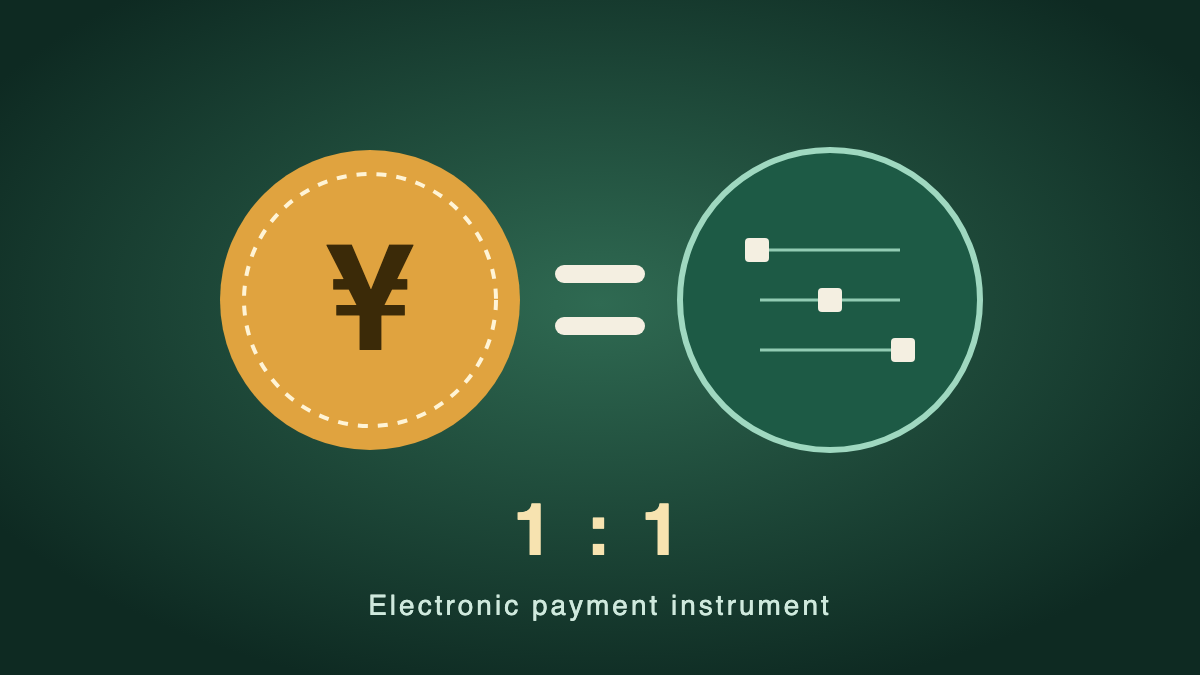
GM, COT❣️ Yuzunoko here.
Have you ever heard "yen stablecoin" and wondered whether it's basically a crypto asset, like Bitcoin?
Under Japanese law, it's treated as something different. JPYC is a stablecoin denominated in Japanese yen, issued by JPYC Inc., a funds transfer service provider, as an "electronic payment instrument" under Japan's Payment Services Act.
According to JPYC Inc., official issuance began on October 27, 2025. Using materials from Japan's Financial Services Agency (FSA, the country's financial regulator) and JPYC Inc.'s official announcements, let's look at where it fits and what's inside.
What's an "electronic payment instrument"?
It all goes back to amendments to the Payment Services Act and other laws that passed on June 3, 2022. The FSA's explanatory materials split stablecoins denominated in a legal currency into two types.
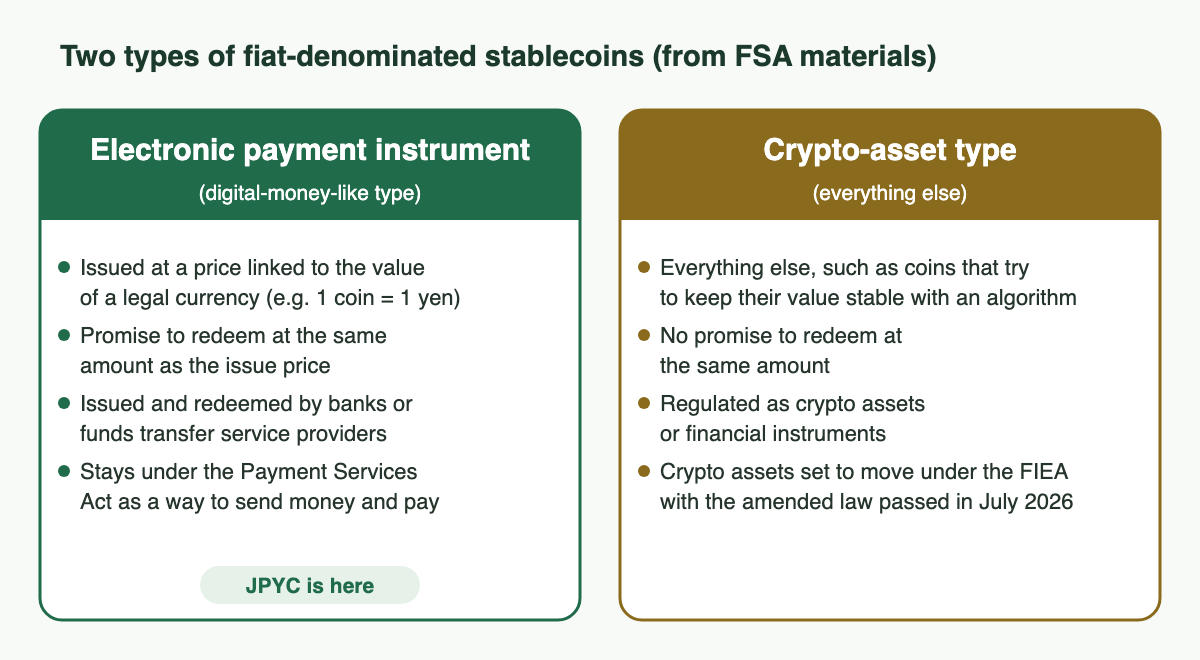
- Digital-money-like type (= electronic payment instrument): issued at a price linked to the value of a legal currency (for example, 1 coin = 1 yen), with a promise to redeem at the same amount as the issue price
- Crypto-asset type: everything else (such as coins that try to keep their value stable with an algorithm)
So the first is regulated as digital money, meaning a way to send money and pay, and the second is regulated as a crypto asset or a financial instrument.
Issuing and redeeming electronic payment instruments counts as an exchange transaction, and is to be done by banks or funds transfer service providers. There's also a setup that uses trust companies.
For businesses that sit between issuers and users as intermediaries, a registration system for electronic payment instrument service providers started in Japan on June 1, 2023.
For the type that uses a trust company (trust-type stablecoins), an amendment to the Payment Services Act that passed on June 6, 2025 widened the rules on reserve assets a little. According to the FSA's explanatory materials, until then the whole amount had to be held in demand deposits, and the change allows up to 50% of the issued amount to be managed in government bonds or time deposits, in a way that doesn't impair the principal.
JPYC isn't trust-type. It's the type issued by a funds transfer service provider, so the issuance setup is different from this.
How it differs from crypto assets
The biggest difference is whether there's a promise that you can turn it back into yen at face value. Electronic payment instruments promise redemption at the same amount as the issue price, and the crypto-asset type has no such promise.
Tax treatment differs too. For electronic payment instruments held by companies, the FAQ from Japan's National Tax Agency explains that they have a character similar to demand deposits and "are considered to fall under monetary claims," and says there's no need to revalue them at market price at the end of the fiscal year. For consumption tax, transferring an electronic payment instrument counts as transferring a means of payment and is tax-exempt.
On the other hand, the FAQ has no question covering how they're treated for individual income tax (I'm not going to guess at what isn't written there).
With an amended law passed in July 2026, it has been decided that crypto assets will move under the Financial Instruments and Exchange Act (FIEA). In the chart in the FSA's April 2026 explanatory materials on that amended law, stablecoins stay under the Payment Services Act and only crypto assets move over to the FIEA.
Here are the differences so far as a diagram.
What's inside JPYC
This is what JPYC Inc.'s announcements say.
- It can be exchanged 1:1 with Japanese yen (issued and redeemed)
- Reserve assets are Japanese yen (deposits and government bonds), covering at least 100% of the outstanding amount
- Issuance and redemption go through the official "JPYC EX," and registering requires identity verification
- It's issued on four chains: Avalanche, Ethereum, Polygon and Kaia
On JPYC EX, the flow is apparently that when you send yen by bank transfer, JPYC is issued to your registered wallet address, and when you send JPYC back, it's paid out in yen to your registered bank account.
The issuance limit was announced to have changed with a May 2026 update, from "1 million yen per day" to "1 million yen per transaction."
So at the center of it all is a really simple promise with numbers: 1 JPYC is 1 yen (a simple design is kind of cool all on its own, I think).
Where issuance stands
In the FSA's list of registered funds transfer service providers (as of July 31, 2026), JPYC Inc. is listed under Director-General of the Kanto Local Finance Bureau No. 00099, with a registration date of August 18, 2025, and its business type as Type II.
On the scale of issuance, JPYC Inc. has announced that as of September 18, 2026, cumulative issuance on JPYC EX passed 10 billion yen. That's the running total of what's been issued, a different number from the amount in circulation now after subtracting what's been redeemed.
The rules are moving bit by bit, too. On May 19, 2026, the FSA promulgated an amendment to a Cabinet Office Order so that trust beneficiary rights under foreign laws equivalent to Japan's framework can be treated as electronic payment instruments (in force from June 1).
About this article
I put this article together from the FSA's materials on the Payment Services Act amendments and its list of registered funds transfer service providers, the National Tax Agency's FAQ on crypto assets, and JPYC Inc.'s official announcements.
The issuance limit and supported chains can change with JPYC Inc.'s updates. Before using it, check JPYC Inc.'s latest announcements.
How taxes and laws apply depends on how you use it and your situation. For individual decisions, please check with a professional such as a tax accountant or lawyer, or in Japan, with a tax office or the FSA's consultation desk. This article is meant to help you understand how things work, and it is not a recommendation to use, buy or sell JPYC or crypto assets.
Quotes from Japanese sources are our own translations.
Translated from the Japanese original.
See you next time on COT❣️