
GM, COT❣️ Yuzunoko here.
Have you ever found an NFT of a cosplay photo you love and thought, "If I buy this, the photo is mine"?
The Copyright Text (FY2026 edition), a guide to copyright published by Japan's Agency for Cultural Affairs (the government agency in charge of copyright), explains that holding an NFT doesn't directly mean you own the content, or its copyright.
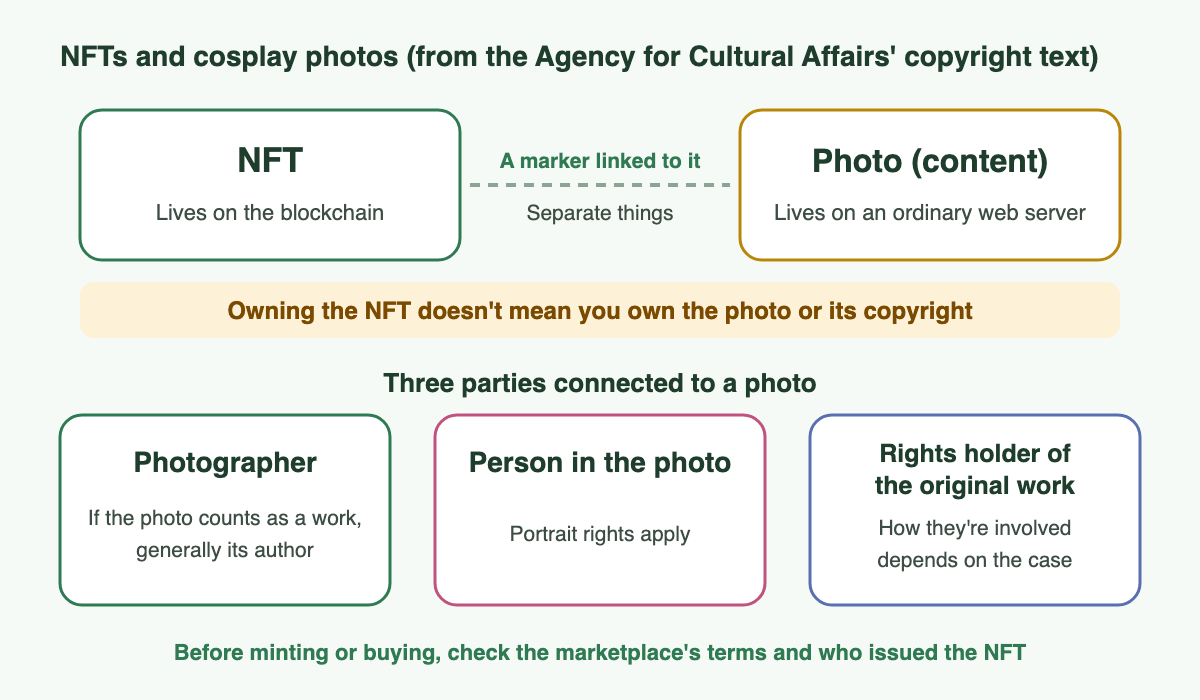
A cosplay photo involves a lot of people, the one who took it, the one in it, and the work it's based on, so there's more to check. Here's the whole picture as a diagram first.
The NFT and the photo itself are different things
As one example of what to know to use NFTs for content safely, the Copyright Text says an NFT is separate from the content. The content sits on an ordinary web server, and the NFT sits on the blockchain.
ethereum.org describes NFTs as a way to represent unique things as Ethereum-based assets, and alongside digital art, its list of uses includes proof that you attended an event and restricting access to content.
The glossary in COT's official whitepaper also says an NFT is a token where "each one is individually distinct," and that NFTs are sometimes used for art, digital cards, membership cards, participation badges and more.
So an NFT is something like a marker linked to the photo. You have to think about it separately from the rights to the photo itself (going by the name alone, it sounds like it can do just about anything, though).
The same idea as buying a painting: the copyright stays put
The Copyright Text also gives the example of selling a painting. Normally, when a painting is sold, what passes from seller to buyer is only "ownership" of the painting as a physical object. Unless there's a contract transferring the copyright, the "copyright" stays with the copyright holder.
That's why, it says, buying the physical painting generally doesn't let you "reproduce" or "exhibit" it without the copyright holder's permission.
With NFTs too, what rights you get from a deal depends on the terms of that deal.
The text recommends checking the terms of use of the NFT marketplace or other service before you buy, and says it's also important to confirm whether the NFT was issued by the copyright holder themselves or an organization or company connected to them.
Three parties connected to a cosplay photo
According to the Copyright Text, photographic works include portraits, landscape photos and so on, and even a photo taken on a smartphone can be a work if it meets the definition.
The author is "the person who creates the work," and if you ask someone else to take the photo, the person who was asked and actually created it is the author, whether or not you paid them.
- The photographer: if the photo counts as a work, they're generally its author
- The person in the photo: portrait rights come into play
- The rights holder of the original work: the side behind the work the character or costume comes from. How they're involved depends on the case
On portrait rights, the text explains that they're the right not to have your name or likeness made public without good reason, and that they're considered a kind of privacy right.
It also notes that in Japan, portrait rights and the right of publicity aren't set out in any law. They're rights established through court cases, and the content, effect, scope and duration of the right of publicity still aren't clear.
A single photo holds the work that went into the costume, the pose, and the photographer's ideas too (cute and cool both packed into one shot is what makes cosplay photos so amazing❣️).
What to check before minting or buying
The Copyright Text says there have been reported cases of third parties who don't hold the rights to content selling NFTs of it without permission.
It also explains that when someone who isn't the copyright holder sells an NFT, copying the content's image or uploading it for a thumbnail could infringe copyrights such as the reproduction right and the public transmission right.
Applying all of this to cosplay photos, here's what's worth checking.
- Who holds the copyright to the photo you want to turn into an NFT (and whether there was an agreement when the shoot was arranged)
- Whether the person in the photo knows it will be made public and sold as an NFT
- What rights the marketplace's terms of use say go to the buyer
- Whether the issuer is the person who holds the rights to the photo, or someone connected to them
For safety on the buying side, the Japan Virtual and Crypto assets Exchange Association (JVCEA, the self-regulatory association for crypto exchanges in Japan) warns about scams that lure you with lines like "get rewards just for connecting" or "join an airdrop," get you to connect your wallet, and then steal your assets.
If a stranger sends you a link about an NFT, it's fine to stop right there first (the more someone rushes you, the more you'll want to take a breath).
About this article
I put this article together from the Agency for Cultural Affairs' Copyright Text (FY2026 edition), ethereum.org's explanation of NFTs, COT's official whitepaper, and the Japan Virtual and Crypto assets Exchange Association's warning.
How rights work changes depending on the photo and the deal. This article isn't legal advice, so for decisions about your own situation, please talk to a lawyer or another professional.
Marketplace terms of use can change, so check the latest version before you use one. This article is not a recommendation to buy or sell NFTs or crypto assets.
Quotes from Japanese sources are our own translations.
Translated from the Japanese original.
See you next time on COT❣️